PAMM, MAM, and Copy Trading: What Are You Actually Investing In?
- Core Infrastructure Comparison
- The Root of the Confusion
- How PAMM Accounts Work
- How MAM Accounts Differ
- Copy Trading: Replicating Trades on Independent Accounts
- Who Controls the Money?
- Understanding Fees and the High-Water Mark
- Key Checks Before Allocating Capital
- Conclusion
- FAQ
- Sources
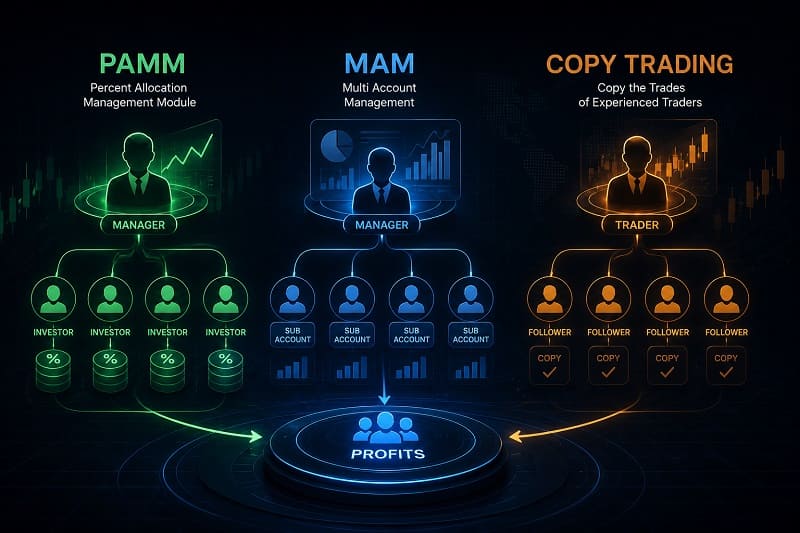
Managed trading is built on a compelling premise: choose an experienced trader, allocate your capital, and let them navigate the markets. Because brokers often place PAMM modules, MAM interfaces, and copy-trading systems in neighboring tabs, it is easy to assume these are just different names for the same service.
They are not. The technical differences between them are fundamental, directly dictating how orders hit your balance, how risks are distributed, and how much operational authority you hand over to a third party.

Core Infrastructure Comparison
To understand where your money actually goes, it helps to see how these three systems handle capital custody, order execution, and customization side by side.
| Feature | PAMM (Percentage Allocation) | MAM (Multi-Account Manager) | Copy Trading (Social Trading) |
|---|---|---|---|
| Capital Structure | Pooled virtually or centrally into a single master account | Independent client accounts linked to a master terminal | Entirely separate, isolated retail accounts |
| Allocation Logic | Strict, automatic percentage-based math | Flexible (Fixed lots, proportional, or risk multipliers) | Proportional scaling based on equity ratios |
| Execution Path | One block trade is executed on the master account | One block trade is split and routed to sub-accounts | Separate trade signals are mirrored across accounts |
| Slippage Risk | None between users (everyone gets the exact same price) | Minimal (depends on the allocation engine) | High (dependent on network latency and execution speeds) |
| Investor Autonomy | None. You cannot modify or close individual live trades | Limited. Custom multipliers can be set before trading | High. You can manually close or modify any copied trade |
The Root of the Confusion
The blurring of lines stems from standardized marketing catchphrases like "Follow the pros" or "Earn while experts trade." These slogans hide the underlying software architecture. Two services can look identical on a broker’s homepage while giving the strategy operator entirely different powers.
The most critical distinction to make is between fund custody and trading authority. The fact that a manager can execute trades does not mean they can access or withdraw your money. For example, in many PAMM setups, brokers utilize a Limited Power of Attorney (LPOA). The manager handles market operations, but the broker strictly controls fund custody, keeping investor capital segregated.
However, a lack of withdrawal access does not protect you from market risk. If a manager utilizes aggressive leverage or leaves losing positions open, their decisions can wipe out your account value. The phrase "your funds remain in your account" guarantees protection against theft, not against poor trading decisions.
Before committing capital to any system, you must establish:
- Who initiates the orders?
- How are positions split among participants?
- Can the connection be severed instantly?
- How are losses allocated?
- What legal framework governs the trading setup?
How PAMM Accounts Work
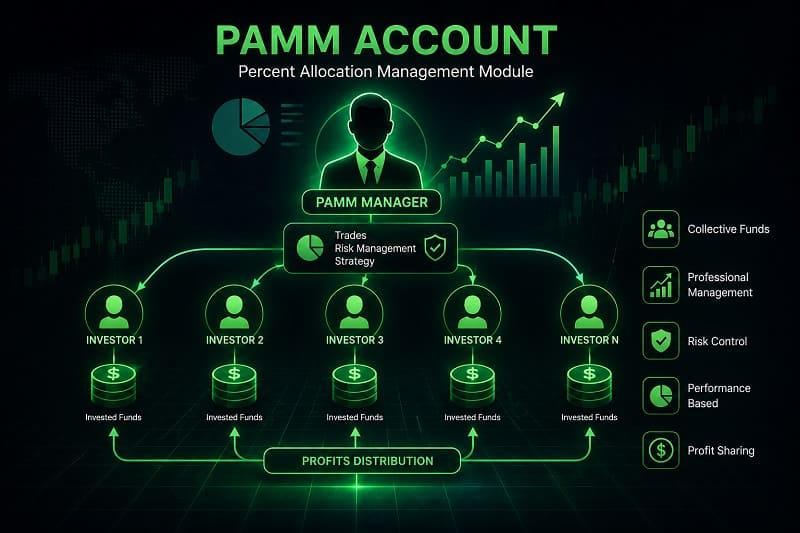
PAMM stands for Percentage Allocation Management Module. The core mechanism of this model is strict, proportional math.
A manager operates a single master account. The PAMM software then automatically distributes trading results — both profits and losses — across all connected investor balances based on their percentage share of the total capital pool.
Example: Three investors contribute $10,000, $30,000, and $60,000 to a master pool. Their relative shares are 10%, 30%, and 60%. If a trade generates a $5,000 gross profit, the module automatically allocates $500, $1,500, and $3,000 respectively. If the trade loses money, the loss is divided using the exact same percentages.
The common belief that investors send money directly to a trader's personal wallet is incorrect. Brokers implement this technically in two ways: some pool the money into a single shared balance, while others keep the investor accounts independent and use software to mirror transactions proportionally.
In a PAMM environment, the investor delegates 100% of individual trade selection. Because you cannot manually close an individual bad trade, your pre-investment check must look beyond historical returns and focus on specific risk metrics:
- The maximum historical intraday drawdown.
- The historical leverage used during growth periods.
- The presence of high-risk strategies like martingale (doubling down on losing trades).
- The net return left over after deducting the manager's performance fee.
Also Read: How to Verify a Broker — A Step-by-Step Guide
How MAM Accounts Differ
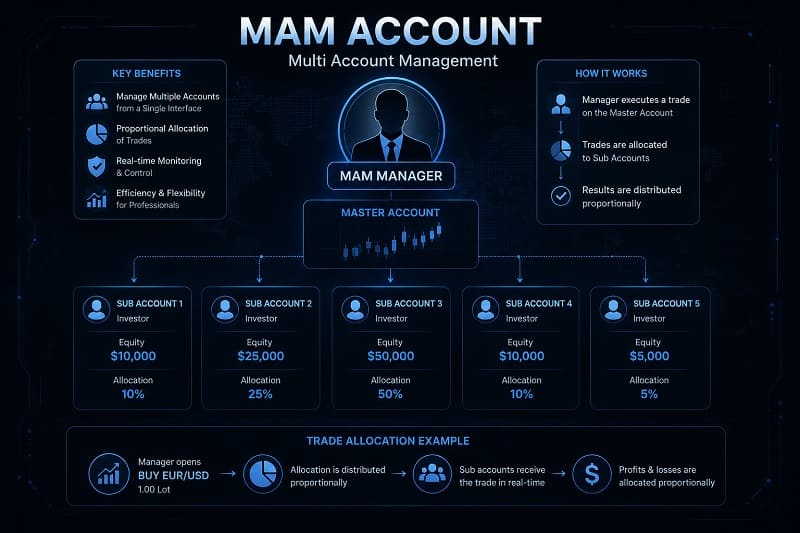
MAM stands for Multi-Account Manager. Like a PAMM, it allows a professional to trade multiple client accounts from a single terminal. However, it gives the operator far more flexibility in how individual order sizes are distributed.
While a PAMM locks everyone into a rigid percentage of the pool, a MAM engine allows the trader to select different allocation methods for each order:
- Fixed lot allocation: Assigning a specific trade size to an account regardless of its balance.
- Proportional allocation: Splitting exposure based on account balance or equity.
- Risk multipliers: Adjusting trade sizes based on an individual investor’s custom risk profile.
If a manager opens a 10-lot position, the MAM software splits it based on these pre-set rules. One account might get 0.5 lots, another 2 lots, and a third 5 lots.
Because of this flexibility, two investors following the same MAM manager can experience entirely different financial outcomes. Variations in account sizes, leverage restrictions, and margin levels mean a trade might execute fully on one account but get blocked on another due to insufficient free margin.
Copy Trading: Replicating Trades on Independent Accounts
Copy trading (often called social trading) functions differently:
- Instead of joining a pool or linking your terminal via a manager interface, you follow a provider’s profile.
- When they open or close a position, the software attempts to replicate that exact action on your separate, isolated account.
- Capital never moves or blends, which provides a stronger sense of personal control.
However, that autonomy is partial. You still delegate the entry points, asset selection, and exit timing. While you can typically set a maximum loss limit or manually close copied trades, the day-to-day transaction flow occurs automatically without your manual approval.
This automation carries legal weight. Regulators like the UK Financial Conduct Authority (FCA) state that when trade signals are executed automatically without client intervention, the service may be classified as portfolio or investment management. If client confirmation is required for each trade, the legal status changes.
Furthermore, an investor's net returns rarely match the provider's leaderboard statistics perfectly. Real-world performance divergence happens due to:
- Slippage: A microsecond delay between the manager’s trade and the copy execution on your account can result in a worse entry price.
- Volume scaling: If a master trader has a $100,000 balance and you have $500, their smaller trades might not scale down precisely due to broker minimum lot limits (typically 0.01 lots). The software must either skip the trade or overexpose your balance.
- Balance changes: Depositing or withdrawing funds while trades are live disrupts the mathematical scaling of the copy software.

Who Controls the Money?
To assess your true exposure, map out the four distinct roles involved in any managed trading setup:
- The Broker (Custodian): Holds your assets and provides the underlying execution infrastructure.
- The Manager (Trader): Generates the trading decisions and market directions.
- The Technology Provider: Supplies the software bridge that copies or allocates the orders.
- The Service Provider (Legal Entity): Bears regulatory responsibility for offering the platform.
A broker might handle all four roles, or they may be split among independent companies. The longer this chain becomes, the more important it is to read the fine print and know where one entity's liability ends and another's begins.
Understanding Fees and the High-Water Mark
The headline returns showcased on broker rankings are typically gross figures. Your actual net yield will be lower due to layered costs: subscription fees, management overhead, wider spreads, and performance fees (the manager's cut of the profits).
Reliable platforms govern performance fees via a High-Water Mark (HWM) mechanism. This accounting standard ensures a manager only earns a percentage on net new profits, preventing them from being paid twice for recovering from a drawdown.
| Accounting Period | Master Account Equity | Performance Fee Status | Reason |
|---|---|---|---|
| Month 1 | Grows $10k to $12k | Fee Paid | Profit generated over the initial deposit ($2k gain). |
| Month 2 | Drops $12k to $9k | No Fee | The account suffered a loss; no profit generated. |
| Month 3 | Recovers $9k to $12k | No Fee | Capital recovered, but did not break the previous $12k peak. |
| Month 4 | Grows $12k to $14k | Fee Paid | Commission is charged only on the new $2k profit peak. |
Before funding an account, verify whether fees are calculated based on closed positions or floating (unrealized) profits, and confirm which administrative costs sit outside the manager's performance fee.
Also Read: Can Your Broker Refuse to Accept Profitable Trades?
Key Checks Before Allocating Capital
A smooth equity curve on a leaderboard does not explain the operational reality of a service. To protect your capital, conduct a basic structural audit:
- Licensing: Regulatory bodies like ESMA enforce strict compliance rules on copy trading under frameworks like MiFID II. Ensure the platform is explicitly licensed to offer automated portfolio management or copy services, rather than just possessing a generic brokerage registration.
- Exit Terms: Know exactly what happens if you disconnect during a volatile market. Will your active positions close instantly at current market prices, or will they remain open for manual management?
- Drawdown History: A strategy that boasts a 100% return after enduring an 85% drop carries an extreme level of risk. Look for consistency and a manageable historical drawdown depth over raw profit spikes.

Conclusion
PAMM, MAM, and copy accounts share just one common trait: they reduce the asset owner's daily workload. Beyond that, they are fundamentally different tools. PAMM relies on rigid pool allocation math; MAM is built for flexible, customized multi-account distribution by asset managers; and copy trading simply mirrors individual signals across disconnected retail portfolios.
When evaluating your options, look past the basic profit percentages on leaderboards. Focus instead on the underlying technical framework, because that framework defines exactly how much control you are handing over, and to whom.
FAQ
Is a PAMM account the same as a mutual fund?
No. A mutual fund is a distinct corporate legal entity with strict regulatory caps on asset allocation. A PAMM is simply an internal software module used by a broker to split trading results across individual accounts.
Can a MAM or PAMM manager steal my funds?
No. The LPOA agreement only grants trading authorization. The manager cannot initiate external bank wires or crypto transfers from your account.
Why are my copy trading results different from the master account?
Performance gaps occur due to execution latency (slippage), rounding errors when trying to scale down lot sizes on smaller deposits, and differences in broker spread structures.
What is a High-Water Mark in simple terms?
It is a rule ensuring a manager only gets paid when your account hits an absolute peak in value. They do not get a fee for simply recovering losses caused by a previous bad month.
Is copy trading considered regulated portfolio management?
Yes. In major jurisdictions like the UK and EU, fully automated copy trading systems that execute trades without requiring manual client approval are regulated as portfolio or investment management services.
Sources
- Financial Conduct Authority — Copy Trading
- European Securities and Markets Authority — Supervisory Briefing on Copy Trading, ESMA35-42-1428
- ESMA — Guidance for Supervision of Copy Trading Services
- IOSCO — Online Imitative Trading Practices: Copy Trading, Mirror Trading, Social Trading
- Dukascopy Bank — PAMM Account Management
- Bybit Help Center — Understanding Discrepancies Between Master Traders and Followers
Get professional help with your case.