
How Scammers Exploit the Reputation of Fidelity Investments to Steal Money
- Why Scammers Target Fidelity Investors
- Fake Calls From "Fidelity Representatives"
- The "Your Account Has Been Locked" Text Message Scam
- Impersonated Financial Advisors and Wealth Managers
- Fake Fidelity Websites and Login Clones
- The Rise of AI Voices and Deepfake Financial Scams
- What Real Users Are Reporting
- How to Verify That Fidelity Really Contacted You
- What to Do If You Already Shared Information
- Conclusion
- FAQ
- Sources
- Need Help?
Trust has become one of the most valuable assets in modern finance. Criminals understand this better than anyone. Rather than creating fake financial firms from scratch, many fraudsters now impersonate established wealth-management institutions to gain credibility instantly.
Among the most frequently abused brands is Fidelity Investments, one of the largest asset managers and brokerage providers in the United States. In recent years, scammers have increasingly used the company's name, branding, and reputation in phishing attacks, fake customer support calls, fraudulent investment offers, and AI-powered impersonation schemes. The firm itself regularly warns clients about phishing, spoofed communications, and other forms of fraud targeting investors.
Why Scammers Target Fidelity Investors
Criminals typically choose brands that people already trust.
The firm manages trillions of dollars in client assets and serves millions of retail and institutional investors. Many account holders maintain retirement portfolios, brokerage/cash management customer profile, and long-term wealth-building plans through the platform.
For fraudsters, this creates an attractive target environment.
| Reason | Why It Appeals to Criminals |
|---|---|
| Strong brand recognition | Victims are more likely to trust communications |
| Large client base | Millions of potential targets |
| Retirement accounts | Often contain significant balances |
| Wealth portfolios | Potential for high-value fraud attempts |
| Established reputation | Reduces suspicion during initial contact |
Unlike traditional cyberattacks, many of today's scams rely on social engineering. The goal is not to break into a system but to persuade victims to reveal information voluntarily.
Fake Calls From "Fidelity Representatives"
One of the most effective fraud techniques involves impersonating customer support personnel.
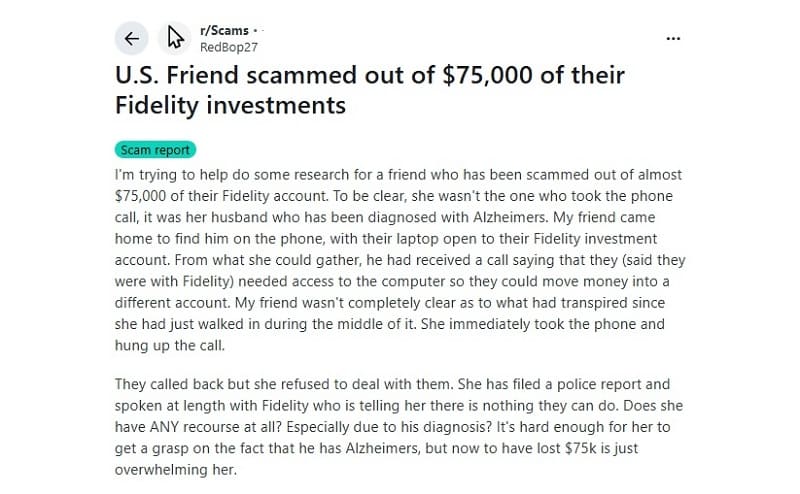
Individuals receive a call from someone claiming to work for the organization's security team. The caller often states that suspicious activity has been detected on the account and immediate action is required.
The conversation is carefully designed to create urgency.
A typical scenario looks like this:
- The victim receives a phone call.
- The caller claims a login attempt has been detected.
- A verification code is sent to the individual's phone.
- The caller requests the code "for security purposes."
- The fraudster uses it to access the account.
Many victims trust these calls because the phone number appears legitimate. Modern spoofing technology allows scammers to disguise their actual number and display information that resembles a genuine financial institution.
| Legitimate Security Team | Fraudulent Caller |
|---|---|
| Will not request your password | May ask for credentials |
| Will not apply for authentication codes | Often inquire about verification codes |
| Encourages independent confirmation | Creates urgency |
| Provides official contact channels | Discourages ending the call |
A simple rule applies: never share one-time passcodes with anyone who contacts you unexpectedly.
The "Your Account Has Been Locked" Text Message Scam
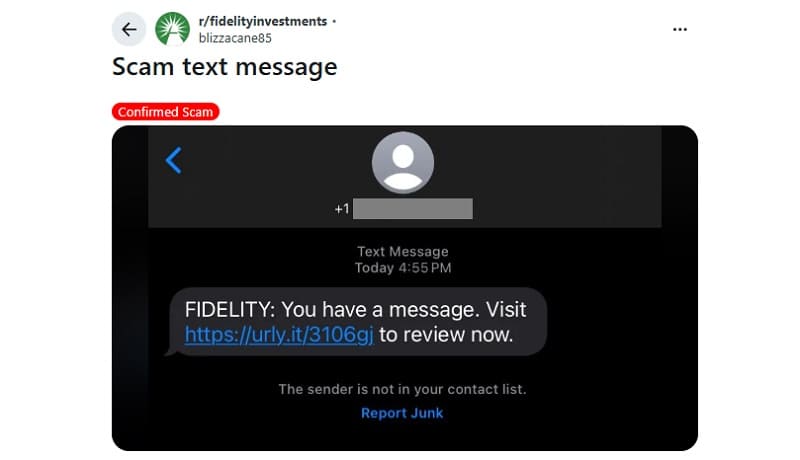
SMS phishing, commonly known as smishing, remains one of the most widespread fraud methods.
The message often claims that the recipient's account has been locked, restricted, or compromised. A link is provided, supposedly directing the user to a secure login page.
In reality, the link leads to a fake website designed to harvest credentials.
Online discussions show numerous reports from users receiving suspicious messages that appear to originate from Fidelity-related services. These notifications frequently contain urgent warnings and requests for immediate action.
| Legitimate Communication | Phishing Text |
|---|---|
| No threats or panic language | Urgent warnings |
| Official company domains | Suspicious web addresses |
| No requests for passwords | Inquires about credentials |
| Clear authentication options | Pressure to click immediately |
Urgency is often the strongest warning sign. The faster someone feels compelled to act, the less likely they are to verify the message independently.
Impersonated Financial Advisors and Wealth Managers
Not all scams begin with a security alert. Some start with what appears to be a professional portfolio opportunity.
Fraudsters increasingly create fake profiles on social media platforms, messaging apps, and professional networks. They present themselves as portfolio managers, retirement specialists, or investment consultants associated with well-known financial institutions.
The conversation often begins casually before shifting toward portfolio opportunities.
Common promises include:
- exclusive wealth-management products;
- unusually high returns;
- insider market opportunities;
- guaranteed profits;
- limited-time offers.
In many cases, scammers use publicly available employee information, professional photographs, and copied corporate branding to appear legitimate.
The sophistication of these operations has increased dramatically, making independent verification more important than ever.
Also Read: The Hidden Danger of WhatsApp/Signal Investment Contact Scams
Fake Fidelity Websites and Login Clones
One of the oldest fraud tactics remains highly effective. Instead of contacting victims directly, criminals create websites that closely resemble legitimate financial platforms.
These sites may copy:
- logos;
- page layouts;
- login forms;
- security notices;
- customer support sections.
Many users assume a website is legitimate because it displays a padlock icon or HTTPS certificate. However, SSL encryption only confirms that a connection is encrypted. It does not verify that the organization operating the website is genuine.
Fraud investigators regularly identify lookalike domains that differ from official websites by only a few characters.
Before entering credentials, users should manually type the official website address rather than relying on links received through messages.
The Rise of AI Voices and Deepfake Financial Scams
Artificial intelligence has transformed online fraud. What once required a poorly written email can now be executed using realistic voice cloning, AI-generated videos, and highly convincing digital identities.
Financial institutions, banks, and asset-management firms have become frequent targets of this trend.
| Traditional Scam | AI-Enhanced Scam |
|---|---|
| Generic phishing emails | Personalized communications |
| Unknown callers | Voice-cloned representatives |
| Static images | Deepfake video content |
| Obvious mistakes | Professional presentation |
A victim may hear what sounds like a professional customer service representative or see a convincing video that appears to feature a market expert.
The challenge is that visual and audio evidence can no longer be trusted automatically.
What Real Users Are Reporting
Consumer complaints often reveal fraud trends before they become widely recognized.
Across investor forums and social media discussions, users have reported:
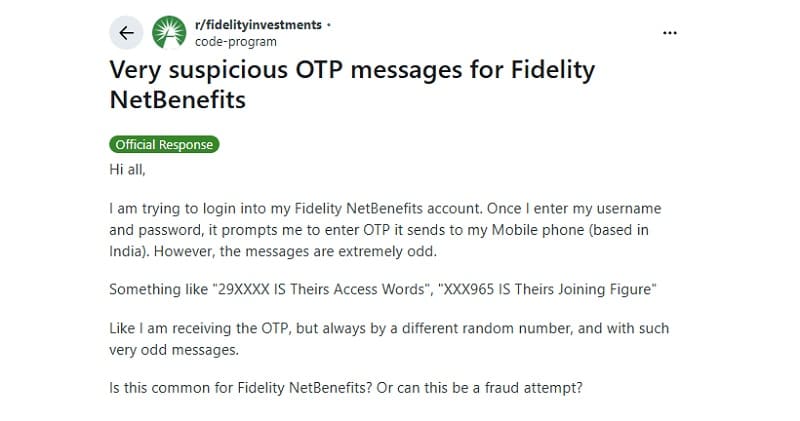
- unexpected authentication code requests;
- suspicious text messages;
- spoofed customer support calls;
- fake account alerts;
- fraudulent verification requirements.
Several users have described receiving security codes despite not initiating login attempts, suggesting that criminals were actively attempting to access their profiles.
Others reported receiving text messages directing them to suspicious websites that closely mimicked legitimate financial portals.
These incidents highlight an important reality: fraud attempts often target individuals long before any actual account compromise occurs.
How to Verify That Fidelity Really Contacted You
Verification should always be independent. If someone claims to represent a financial institution, assume nothing until you confirm it yourself.
| Authentication Method | Recommended? |
|---|---|
| Call the official number listed on the website | Yes |
| Click a link in a text message | No |
| Share an authentication code | No |
| Log in directly through the official website | Yes |
| Verify notifications inside your profile | Yes |
A legitimate representative will never object if you end the conversation and call back using an official number.
Fraudsters often rely on keeping victims engaged and preventing independent verification.
Also Read: Top Resources for Checking Crypto Projects
What to Do If You Already Shared Information
If you believe you may have interacted with a scammer, act immediately.
Recommended steps include:
- Change passwords associated with affected accounts.
- Enable multi-factor authentication.
- Contact the organization directly.
- Review recent profile activity.
- Secure linked banking information.
- Monitor credit reports and identity-related activity.
- Report the incident to relevant authorities.
For U.S. residents, reports can also be submitted to the Federal Trade Commission and the Federal Bureau of Investigation.
Conclusion
The most dangerous scams involving Fidelity do not require hacking sophisticated systems or bypassing advanced security controls.
Instead, they exploit something far simpler: trust.
By impersonating a respected firm, scammers can persuade victims to reveal credentials, approve transactions, or transfer funds voluntarily. The rise of AI-generated voices, deepfake videos, and increasingly realistic phishing campaigns has made these attacks more convincing than ever.
The strongest defense is not technology alone. It is verification. Every unexpected call, message, email, or wealth-building proposal should be treated with caution until its authenticity has been independently confirmed.
FAQ
Does Fidelity call customers about suspicious activity?
Yes, but users should independently verify any unexpected communication using official contact information.
Can scammers spoof company’s phone numbers?
Yes. Caller ID spoofing allows fraudsters to display numbers that appear legitimate.
Are Fidelity text messages always safe?
No. Criminals frequently send phishing notifications that imitate legitimate security alerts.
What should I do if I shared a verification code?
Contact the institution immediately, change passwords, and review account activity.
Can AI be used in financial scams?
Yes. Voice cloning and deepfake technology are increasingly being used in online fraud.
How can I verify a Fidelity website?
Type the official website address manually and avoid clicking links from unsolicited messages.
Are fake financial advisors common?
Yes. Fraudsters frequently impersonate investment professionals on social media and messaging platforms.
What is the biggest warning sign of a scam?
Urgency. Most fraud schemes attempt to pressure victims into acting before they have time to verify the situation.
Sources
- Fidelity Security Center – Fraud and Phishing Awareness
- U.S. Federal Trade Commission (FTC)
- Fidelity Investor Protection Resources
- FBI Internet Crime Complaint Center (IC3)
- Reddit user reports involving phishing and spoofing attempts
- Financial industry guidance on AI-enabled fraud and social engineering attacks
Need Help?
If you encountered a platform, agent, or website claiming affiliation with Fidelity Investments — offering high‑return investment plans, early access to IPOs, or "exclusive" crypto trading desks — and you've since been unable to withdraw your money, you can request a free consultation with StockView specialists.
An expert review can help determine whether your case involves a brand‑impersonation scam and assess realistic recovery options, including tracing fund flows and filing disputes through banking or crypto channels.
Get professional help with your case.