Deepstitch AI / DeepSnitch AI: Full Investigation of a Multi-Layer Crypto Presale Scam
- Domain Infrastructure: A Funnel, Not a Platform
- Domain Signals: Age, Anonymity, and Risk Indicators
- Step-by-Step Scam Flow
- Second Attack Layer: Wallet Interaction
- Why This Scheme Works
- Structural Analysis: What Type of Scheme Is This?
- Risk Assessment
- Conclusion: Is Deepstitch AI Legit?
- FAQ
- Final Takeaway
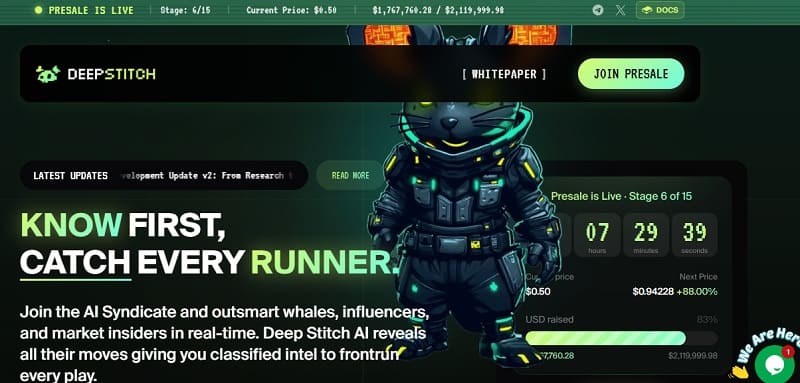
The Deepstitch AI / DeepSnitch AI ecosystem does not operate like a typical crypto startup. At first glance, it presents itself as an AI-driven analytics platform offering early token access. But when examined structurally, it reveals something fundamentally different: a coordinated system designed to extract funds through multiple layers of deception.
This is not a single suspicious website. It is a distributed scam architecture, combining fake presale mechanics, wallet-drainer behavior, and a scalable domain network.
Domain Infrastructure: A Funnel, Not a Platform
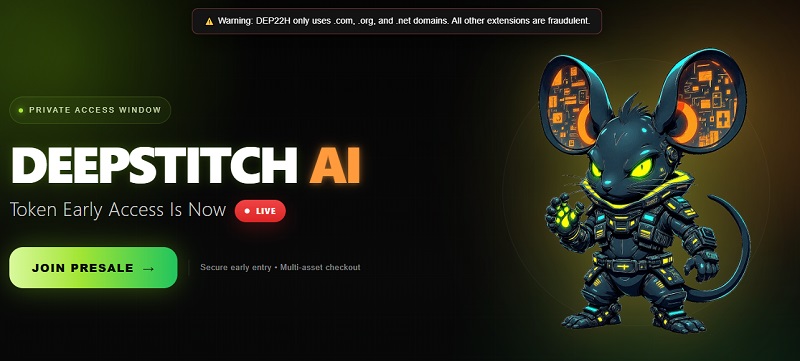
Unlike legitimate crypto projects, which rely on a single verified domain, this system is built as a multi-layer funnel:
Entry Layer (traffic bait):
- dep22h.com
- dep36h.com
- dep100v.com and others
Payment Layer:
- deepstitchai.net
Legitimization Layer:
- deepsnitch.ai
Each layer serves a different function:
- bait domains attract traffic
- payment domain collects funds
- “official” site simulates legitimacy
This structure closely matches patterns identified in academic research, where scam operations deploy clusters of similar domains to scale attacks and evade detection. In other words, this is not branding — it is infrastructure.
Domain Signals: Age, Anonymity, and Risk Indicators
Technical analysis reinforces this conclusion.
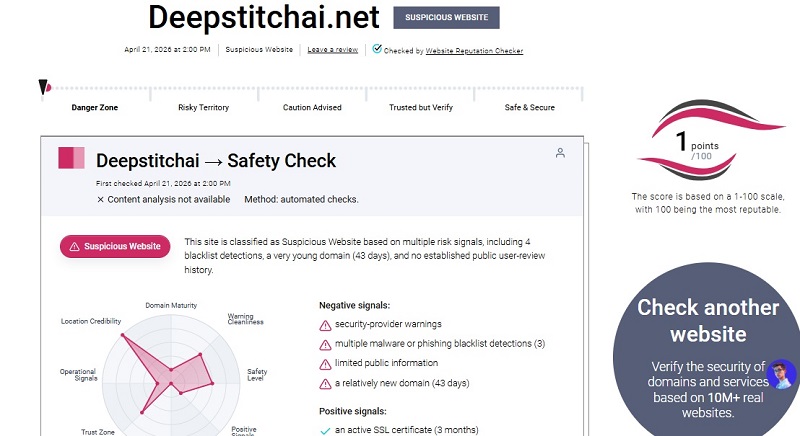
deepstitchai.net
- Created: March 9, 2026
- Updated: same day
- Hosting: Cloudflare (USA)
- Ownership: hidden
Source: DomainTools
Security signals:
- flagged by threat databases
- extremely low trust score (1/100)
- categorized in “danger zone”
Source: GridinSoft
Newly created domains with no history are a common trait of scam campaigns.
deepsnitch.ai
- Created: February 10, 2025
- Updated: April 2026
- Ownership hidden via privacy service
Source: DomainTools
Security signals:
- moderate trust score (35/100)
- flagged by multiple detection engines
- labeled as “risky”
Source: GridinSoft
👉 The combination of hidden ownership and risk flags significantly increases uncertainty.
Step-by-Step Scam Flow
- Entry: Controlled First Impression
The user lands on one of the “dep” domains. The page presents:
- “Token Early Access”
- “JOIN PRESALE”
- support for multiple cryptocurrencies
This creates:
- urgency (limited access)
- exclusivity (early entry)
- perceived opportunity
- Redirect: Transition Into the Funnel
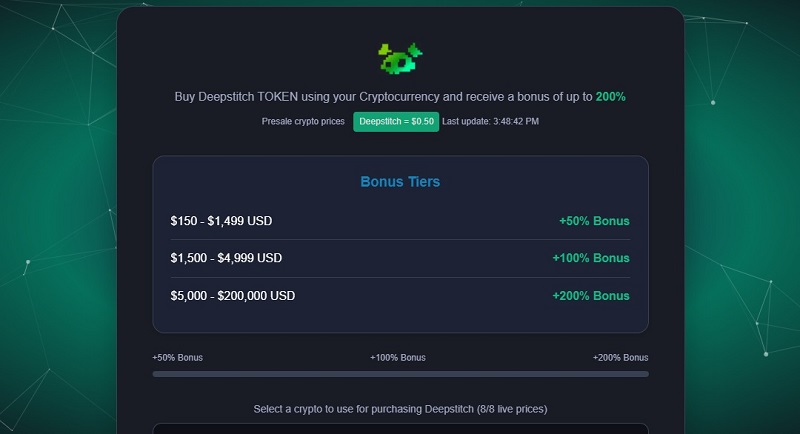
Clicking the CTA redirects to: deepstitchai.net. Here, the interface mimics a legitimate crypto purchase flow:
- user selects amount
- chooses asset
- receives QR code and wallet address
At this stage, everything appears consistent with real presales — until the critical deviation occurs.
- Critical Deception: Manual Payment Instead of Smart Contract
The system instructs the user to send funds directly to a wallet.
There is:
- no smart contract
- no automated token issuance
- no on-chain logic
This transforms the process into a simple irreversible transfer.
In real crypto systems:
- transactions interact with contracts
- logic is enforced on-chain
Here trust is replaced with blind transfer. This is the point where the system stops being “crypto” and becomes pure extraction.
- Fake Transaction Confirmation
After payment, users receive identifiers like PZMJIXDXS3.
This is not:
- a blockchain hash
- a verifiable transaction
It is an internal string used to simulate legitimacy. This technique creates the illusion of processing while no real blockchain event exists.
- Delayed Trust Mechanism
Users are told: “The contract address will be sent via email.” This is one of the most critical manipulation points. Because in real blockchain logic the contract must exist before interaction.
If it appears “after payment,” it means:
- no real contract is involved
- no actual token purchase occurred
This delay prevents immediate realization of fraud and keeps users engaged.
Also Read: How to Avoid Phishing and Fake Crypto Websites
Second Attack Layer: Wallet Interaction
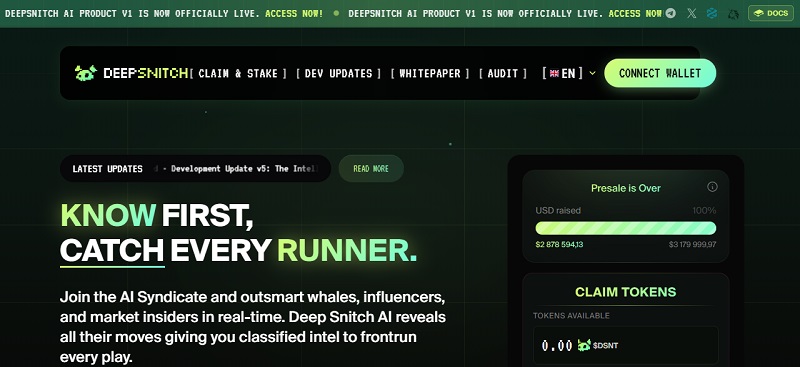
On the “official” site (deepsnitch.ai), users encounter a second mechanism: Connect Wallet.
This introduces a more advanced risk. User reports include warnings such as: “This transaction may be attempting to steal your funds.”
This strongly indicates malicious smart contract behavior.
How This Works Technically
Possible mechanisms:
- unlimited token approvals
- hidden permissions
- delayed draining scripts
Once a user signs:
- assets can be moved without further action
- multiple tokens can be accessed
- draining can occur later
This is known as a wallet drainer, a common attack in modern crypto fraud.
Why This Scheme Works
The effectiveness of this system lies in combining three layers:
- Technical Illusion
- fake transaction IDs
- absence of a contract
- pseudo DeFi interface
- Psychological Manipulation
- urgency (“early access”)
- reward expectation
- sunk cost effect
- Scalable Infrastructure
- interchangeable domains
- replaceable entry points
- reusable templates
Research shows that such systems often replicate across multiple domains to maximize reach and profit.
Structural Analysis: What Type of Scheme Is This?
The Deepstitch / DeepSnitch system is not a single scam type. It is a hybrid model combining multiple attack vectors:
| Component | Function |
|---|---|
| Fake Presale | Creates illusion of investment opportunity |
| Deposit Scam | Extracts funds via direct transfer |
| Funnel System | Scales traffic via multiple domains |
| Wallet Drainer | Enables secondary asset theft |
This dual-layer monetization is key:
- Immediate profit from deposits
- Additional profit from compromised wallets
Risk Assessment
| Indicator | Risk Level |
|---|---|
| Mirror domain network | VERY HIGH |
| Newly created domain | HIGH |
| Manual crypto payments | CRITICAL |
| No smart contract | CRITICAL |
| Fake transaction ID | CRITICAL |
| Wallet-drainer warnings | CRITICAL |
| Hidden ownership | HIGH |
Conclusion: Is Deepstitch AI Legit?
From a structural and technical perspective, the system does not align with how legitimate crypto presales operate.
Instead, it matches patterns associated with:
- advance-fee crypto scams
- phishing-based wallet compromise
- multi-domain fraud infrastructure
Promotional materials around the project rely heavily on hype and unverified claims, a common pattern in speculative or misleading campaigns.
A careful, evidence-based conclusion:
Deepstitch AI / DeepSnitch AI exhibits multiple high-risk characteristics consistent with coordinated crypto scam operations.
FAQ
Why do scam projects use multiple domains?
To scale traffic, bypass blocks, and quickly replace banned sites.
Is sending crypto to a wallet a valid presale method?
No. Legitimate presales use smart contracts, not manual transfers.
What does a fake transaction ID mean?
It indicates there is no real blockchain transaction behind it.
Can a contract be sent after payment?
No. In real systems, contracts must be public before interaction.
What happens if I connect my wallet?
You may grant permissions that allow attackers to drain funds.
Can funds be recovered?
In most cases, no — blockchain transactions are irreversible. However, blockchain analytics specialists may assist in tracing the movement of funds and, in limited cases, support potential recovery efforts, particularly if the assets can be linked to identifiable entities such as centralized exchanges.
Final Takeaway
This system is not a product. It is a financial funnel disguised as a crypto presale.
If you are asked to send crypto directly to a wallet or receive contract details only after payment, you are not participating in blockchain finance — you are entering a controlled extraction system.
Get professional help with your case.