
Broker Loyalty Programs: Real Benefits or Just Another Retention Strategy?
- Why Client Retention Has Become a Strategic Priority
- The Most Common Incentive Models Used by Brokers
- Why Incentives Influence Client Behavior
- Who Actually Benefits From These Schemes?
- When Incentives Start Working Against You
- Cashback vs Better Trading Conditions
- Common Types of Client Incentive Structures
- The Business Logic Behind These Systems
- What Should Clients Evaluate Before Joining?
- Benefits and Potential Drawbacks
- How These Systems Are Evolving
- Conclusion
- FAQ
- Sources
- Need Help?
For years, brokers competed primarily on execution quality, spreads, regulation, and market access. In 2026, however, another factor increasingly influences where clients choose to open and maintain accounts: incentive schemes.
Cash rebates, status tiers, premium services, exclusive research, and account privileges have become common features across forex, CFD, and multi-asset platforms. Some providers now devote significant resources to building entire client-engagement ecosystems that look remarkably similar to airline frequent-flyer programs or premium credit-card memberships.
The obvious question is whether these benefits genuinely improve the customer experience or simply represent sophisticated retention mechanisms designed to increase activity.
The reality is more nuanced than either side of the debate suggests.
Why Client Retention Has Become a Strategic Priority
The brokerage industry has become increasingly competitive. Technology has lowered entry barriers, while account-opening processes have become faster and more accessible than ever.
At the same time, attracting new customers has become significantly more expensive. Marketing costs continue to rise, and firms face intense competition across nearly every segment of the market. As a result, many companies have shifted their attention toward retaining existing customers rather than focusing exclusively on acquisition.
From a business perspective, this approach makes perfect sense.
A client who remains active for several years is substantially more valuable than someone who closes an account after a few months. This is why modern brokers increasingly rely on membership tiers, account privileges, and transaction-based incentives to strengthen long-term relationships.
The concept is not unique to financial services. Airlines, hotels, streaming platforms, and retail brands have used similar methods for decades. The underlying goal remains the same: encourage customers to stay engaged and reduce the likelihood of switching to competitors.

The Most Common Incentive Models Used by Brokers
Although every company structures its offerings differently, most retention systems fall into several broad categories.
- The simplest model involves transaction rebates. Under this approach, a portion of commissions or trading costs is returned to the customer based on account activity.
- Other platforms use point-based systems. Participants accumulate points over time and can exchange them for various benefits, including cash credits, educational resources, analytical tools, or account upgrades.
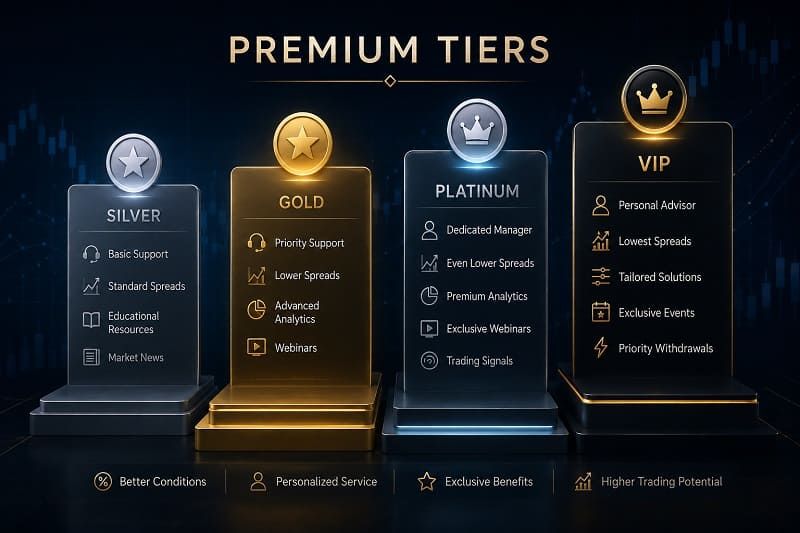
- Tiered membership structures are also increasingly popular. Clients move through levels such as Silver, Gold, Platinum, or Diamond as they meet predefined requirements. Higher levels typically unlock additional services and preferential conditions.
Typical benefits may include:
- reduced transaction costs;
- priority customer support;
- advanced market research;
- exclusive educational content;
- dedicated account managers;
- faster processing of requests;
- access to special promotions.
The specific structure varies from one platform to another, but the objective remains largely consistent: encourage long-term engagement while rewarding higher-value customers.
Also Read: How Scam Brokers Operate in 2026
Why Incentives Influence Client Behavior
The popularity of these systems is closely tied to behavioral psychology.
Research in consumer behavior consistently shows that people respond strongly to progress indicators, status recognition, and visible achievements. This explains why airline memberships, hotel status programs, and premium banking tiers remain highly effective.
Financial platforms use many of the same psychological triggers.
Someone approaching a higher membership tier may feel motivated to maintain activity levels. Likewise, an individual who has already accumulated substantial benefits may be less inclined to move to a competing provider.
Importantly, the attraction is not always financial. Status itself can become a powerful motivator.
Progress bars, membership badges, and exclusive privileges create a sense of achievement that extends beyond the monetary value of the benefits themselves.
Who Actually Benefits From These Schemes?
Not all customers receive equal value from retention initiatives.
For highly active market participants, some structures can provide meaningful economic advantages.
- A client executing hundreds of transactions each month may accumulate significant rebates over time. Lower commissions, tighter pricing conditions, and premium analytical resources can materially improve overall efficiency.
- Professional and semi-professional participants often benefit from enhanced support services as well. Faster communication channels, dedicated account representatives, and advanced research tools may provide practical advantages during volatile market conditions.
In these situations, additional perks function as genuine cost-reduction mechanisms rather than mere marketing features.
For individuals who already maintain substantial activity levels, receiving extra benefits for behavior that would occur regardless can represent a legitimate advantage.

When Incentives Start Working Against You
The picture becomes more complicated when people alter their behavior solely to qualify for additional benefits.
This is one of the least discussed aspects of modern retention systems.
A rebate only creates value if the underlying transaction would have occurred anyway. Problems emerge when customers increase activity simply to reach the next tier or unlock additional privileges.
Someone may open extra positions, increase volume, or trade more frequently in pursuit of status upgrades. While the value of benefits increases, overall costs often rise as well.
This creates a paradox.
An individual can earn more rebates while simultaneously reducing overall profitability.
The structure itself is not deceptive. The incentives are usually disclosed clearly. However, the psychological impact of tier progression can sometimes encourage decisions that would not otherwise have been made.
Understanding this dynamic is essential for evaluating whether a particular scheme genuinely aligns with one's objectives.
Cashback vs Better Trading Conditions
One of the most overlooked questions is whether rebates provide more value than consistently competitive pricing.
Consider two hypothetical examples:
- Platform A offers attractive rebates but slightly wider spreads.
- Platform B provides lower costs from the outset but offers no additional incentives.
At first glance, Platform A may appear more attractive because customers receive something back.
However, after calculating total execution costs over hundreds of transactions, Platform B may prove significantly cheaper.
This illustrates an important principle. Benefits should be evaluated as a supplement to core trading conditions, not as a substitute for them.
Competitive pricing, reliable execution, strong regulation, and transparent operations generally have a greater impact on long-term outcomes than any membership scheme.
Common Types of Client Incentive Structures
| Type | Typical Benefit | Primary Objective |
|---|---|---|
| Transaction rebates | Partial cost reduction | Increase activity |
| Points-based systems | Redeemable benefits | Encourage engagement |
| Status tiers | Premium services | Improve retention |
| Referral initiatives | Acquisition bonuses | Expand customer base |
| Trading contests | Cash prizes or perks | Increase participation |

The Business Logic Behind These Systems
From the broker's perspective, these initiatives solve several challenges simultaneously.
They help:
- reduce customer churn,
- increase engagement,
- strengthen brand attachment,
- create switching costs.
Providers that develop CRM and retention software openly describe these systems as tools designed to increase customer lifetime value. The longer a client remains active, the greater the revenue potential for the company.
This does not necessarily mean such schemes are harmful. In many cases, both sides benefit.
Customers receive additional services, lower costs, or enhanced support, while firms strengthen long-term relationships.
The key is recognizing that these initiatives are business tools first and customer benefits second.
Also Read: Why More Traders Are Leaving MetaTrader for cTrader and TradingView
What Should Clients Evaluate Before Joining?
Before becoming attracted by membership tiers or cashback percentages, it is important to assess the actual economics behind the offer.
Several questions deserve careful consideration:
- How much activity is required to qualify?
- What is the real monetary value of the benefits?
- Are earned credits withdrawable?
- Does participation encourage unnecessary transactions?
- Would lower costs elsewhere provide greater value?
- Are there restrictions on redemption?
Answering these questions often reveals whether a particular offer delivers meaningful value or primarily serves promotional purposes.
Benefits and Potential Drawbacks
| Feature | Potential Advantage | Possible Risk |
|---|---|---|
| Transaction rebates | Reduced costs | May encourage excessive activity |
| Premium tiers | Enhanced service | Often require high volume |
| Points systems | Additional perks | Limited redemption flexibility |
| Competitions | Extra earning opportunities | Can encourage aggressive behavior |
| Referral bonuses | Additional income | Usually short-term value |
How These Systems Are Evolving
The industry is gradually moving beyond simple cashback and points.
Many firms are now experimenting with personalized benefits, AI-driven incentives, and ecosystem-based engagement models. Some platforms tailor offers to individual customer behavior, while others integrate educational content, analytical tools, and premium services into broader membership structures.
The direction is clear.
Future retention initiatives are likely to become more customized, more data-driven, and more deeply integrated into the overall customer experience.
Rather than focusing solely on rebates, companies increasingly seek to create entire ecosystems that encourage long-term engagement.
Conclusion
Broker loyalty programs are neither scams nor guaranteed sources of value.
They are customer-retention tools designed to strengthen long-term relationships while encouraging platform engagement. Their effectiveness stems from a combination of economic incentives and behavioral psychology.
For high-volume clients, these systems can generate meaningful benefits through lower costs, premium services, and enhanced support. For less experienced market participants, however, chasing status upgrades may become more expensive than the benefits themselves.
The most sensible approach is to evaluate regulation, execution quality, costs, and platform reliability first.
If additional perks improve an already competitive offering, they should be viewed as a bonus rather than the primary reason for choosing a broker.
FAQ
What are broker incentive schemes?
They are structured benefit systems that provide rebates, premium services, status levels, or other advantages based on account activity.
How do cashback offers work?
A portion of commissions or transaction costs is returned to the customer based on predefined conditions.
Are premium membership tiers worth pursuing?
For highly active clients, they can provide meaningful value. For occasional users, the benefits are often limited.
Can these initiatives improve profitability?
They may reduce costs, but they cannot compensate for poor risk management or weak trading decisions.
Why do brokers introduce these systems?
Primarily to improve customer retention, increase engagement, and strengthen long-term relationships.
What is a transaction rebate?
It is a partial refund based on account activity, usually calculated from volume or commissions.
Are earned benefits always withdrawable?
Not necessarily. Terms vary significantly between providers.
Can tiered systems encourage overtrading?
Yes. Some participants increase activity levels solely to qualify for additional privileges.
What should be compared before joining?
Execution quality, fees, regulation, withdrawal policies, and qualification requirements.
Are these initiatives becoming more common?
Yes. Growing competition has encouraged many firms to develop increasingly sophisticated customer-retention models.
Sources
- FX Back Office — Loyalty Systems That Work: Points, Rewards and Trader Tiers
- Brokeree Solutions — The Future of Loyalty Programs
- VT Markets Loyalty Program
- Harvard Business Review — The Value of Keeping the Right Customers
Need Help?
If you lost money while working with a broker, whether due to misleading promotions, account restrictions, withdrawal issues, or other disputes, it may be worth understanding what options are available.
StockView specialists offer free consultations to review individual situations, assess the circumstances of the loss, and evaluate the potential chances of recovering funds.
Get professional help with your case.