
Aurum Foundation Review: AI Wealth Platform or Global MLM Ponzi?
- Why Aurum Looks Like a Legitimate AI Fintech
- Regulatory Warnings Across Multiple Jurisdictions
- The AI Narrative vs. The Recruitment Reality
- Inside the Recruiting Calls
- Can the Promised Returns Be Realistic?
- Growing Balances Do Not Mean Accessible Funds
- The Withdrawal Trap
- The Expanding Domain Network
- What Former Participants Report
- Conclusion
- FAQ
- Sources
- Need Help?
The cryptocurrency industry has seen a new generation of investment projects emerge over the past two years. Unlike traditional Ponzi schemes that relied on unrealistic promises and poorly designed websites, many modern operations present themselves as sophisticated fintech companies. Artificial intelligence, algorithmic trading, digital banking and institutional infrastructure have become recurring marketing themes.
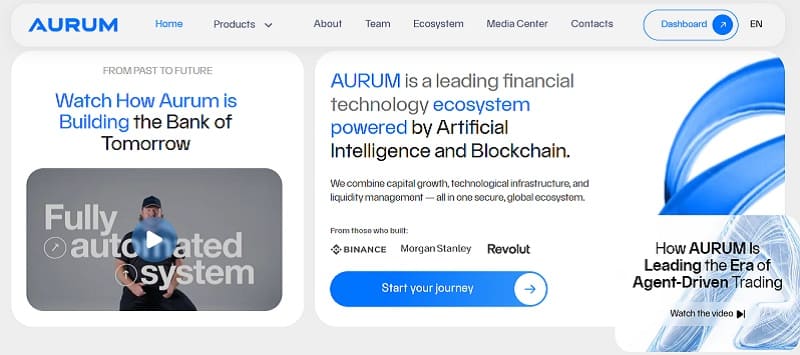
Aurum Foundation fits this trend. Publicly, the project describes itself as an AI-powered financial ecosystem offering automated trading, digital banking and wealth-building opportunities. However, financial regulators across multiple jurisdictions have issued warnings, while investigative reporting and victim accounts raise serious questions about how the business actually operates.
Why Aurum Looks Like a Legitimate AI Fintech
At first glance, Aurum Foundation resembles many legitimate financial technology companies that entered the digital asset market after the rapid expansion of artificial intelligence.
The platform presents itself as an international investment ecosystem rather than a simple cryptocurrency project. Promotional materials highlight:
- proprietary AI engines,
- algorithmic portfolio management,
- automated trading strategies,
- digital payment solutions,
- a future "NeoBank" ecosystem.
Visitors are introduced to products with names such as EX-AI, Zeus, Neyro and other AI-branded services.
The presentation follows a pattern now common across the fintech sector. Instead of encouraging speculative trading, the company focuses on concepts that sound familiar to mainstream investors:
- artificial intelligence
- financial automation
- institutional infrastructure
- digital banking
- portfolio optimisation
- passive income through proprietary technology
This approach significantly increases credibility. Investors no longer feel they are joining an experimental crypto project. Instead, they are invited to participate in what appears to be a mature financial platform built around emerging technologies.
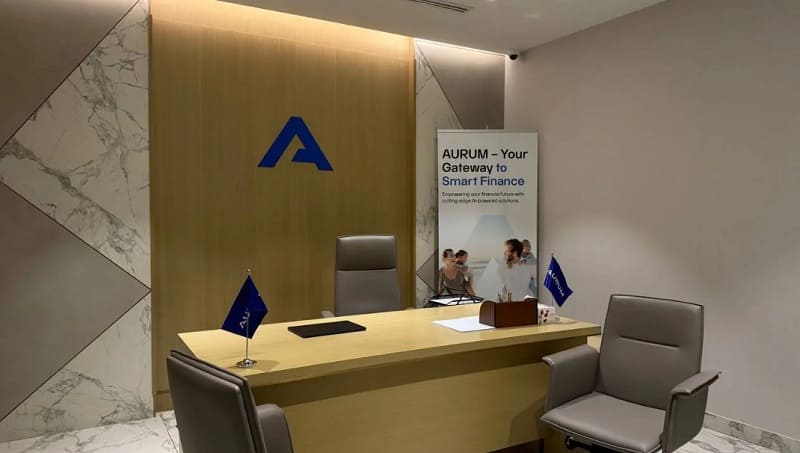
The visual presentation reinforces that impression. Professional branding, polished videos, multilingual content and references to international expansion create the appearance of an established organisation. Marketing materials frequently mention Dubai, Hong Kong and other global financial centres.
The investment proposition itself is equally polished. Rather than advertising "quick riches," promotional content often speaks about long-term wealth creation, AI-assisted portfolio management and sustainable passive income.
Yet attractive branding alone does not demonstrate that a financial model is genuine. Regulators generally evaluate licensing status, corporate transparency, operational history and the actual source of investor returns — not the quality of a website.
Several authorities have concluded these aspects deserve scrutiny.
Also Read: How Scammers Exploit the Reputation of Fidelity Investments to Steal Money
Regulatory Warnings Across Multiple Jurisdictions
The following regulators have published official warnings or included the project in their public alert databases:
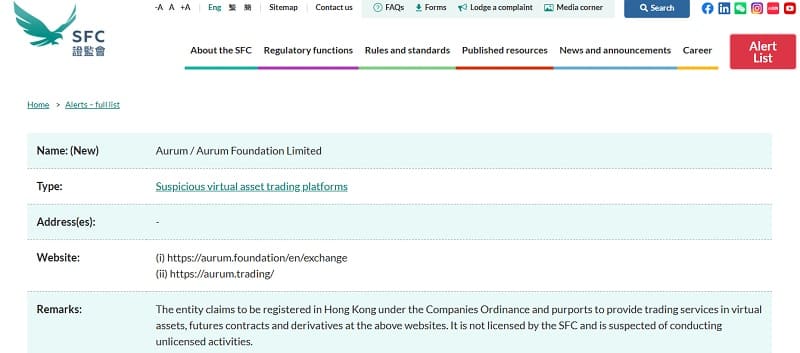
- The Hong Kong Securities and Futures Commission added Aurum Foundation to its Alert List of suspicious virtual asset trading platforms after stating that the entity claimed to provide virtual asset trading services without holding the required licence.
- The Financial Markets Authority of New Zealand subsequently advised investors to exercise caution, referring to overseas regulatory warnings and identifying the platform as a business promoted through social media and personal networks.
- The Bank of Russia continues to classify Aurum Foundation as an organisation displaying signs consistent with a financial pyramid.
- Nigeria's Securities and Exchange Commission has warned that Aurum Bot is neither registered nor licensed and exhibits characteristics commonly associated with Ponzi schemes.
- France's Autorité des Marchés Financiers placed aurum.foundation on its cryptocurrency blacklist for offering financial services without authorisation.
- The UK's Financial Conduct Authority has also listed multiple related domains as clone websites impersonating an authorised firm.
These warnings do not automatically determine the legality of every activity connected with the project. However, they demonstrate that concerns have been raised independently by multiple public authorities across different jurisdictions.
The AI Narrative vs. The Recruitment Reality
Perhaps the most revealing contrast appears when Aurum's public messaging is compared with discussions inside its own recruitment events.
Externally, the project presents artificial intelligence as the core engine responsible for generating returns. Company representatives describe proprietary analytical systems and institutional-grade infrastructure.
That image changes noticeably inside recruitment meetings. A recent investigation by Disruption Banking attended one of Aurum Foundation's internal Zoom presentations intended for prospective affiliates. According to the report, discussion focused overwhelmingly on referral marketing, network expansion and methods for introducing new participants. Detailed explanations of the advertised AI infrastructure received comparatively little attention.
During the presentation, participants were encouraged to master what speakers described as "referral marketing" and "direct sales." Presenters also suggested that prospective recruits should spend less time explaining complex AI systems and more time reducing hesitation among potential members.
Legitimate quantitative investment firms typically devote considerable attention to explaining governance, portfolio management, risk controls, custody arrangements and investment methodology. When recruitment consistently receives greater emphasis than the underlying investment process, regulators often view this as a characteristic requiring additional scrutiny.
| Public Marketing | Observed Recruitment Focus |
|---|---|
| AI-powered trading infrastructure | Referral marketing and network growth |
| Algorithmic wealth management | Recruiting new participants |
| Institutional fintech ecosystem | Building affiliate teams |
| Automated investment technology | Sales presentations and onboarding |
| Financial innovation | Community expansion and commissions |
Inside the Recruiting Calls
An investigation published by Disruption Banking offers an unusual opportunity to compare public marketing with internal messaging. Journalists attended one of the organisation's internal Zoom presentations and observed how newcomers were introduced to the business model.
- The public website presents an ecosystem built around artificial intelligence, digital banking and advanced financial technology. Inside the recruiting presentation, however, the emphasis reportedly shifted elsewhere.
- According to the published investigation, speakers devoted most of their time to referral marketing, duplication strategies and methods of expanding distribution networks. Rather than explaining how trading algorithms produce returns, presenters focused on reducing hesitation among prospective recruits.
- Recruiters reportedly advised participants not to overwhelm prospects with technical explanations. Their objective was simply to remove uncertainty and make it easier for newcomers to join.
Professional asset managers typically spend considerable time discussing portfolio construction, investment methodology, risk controls, custody arrangements and regulatory oversight. Recruitment incentives generally occupy a secondary role. When promotional meetings devote substantially more attention to network expansion than to the underlying financial product, analysts often view this as a warning sign.
Can the Promised Returns Be Realistic?
Various marketing materials describe AI-powered systems capable of producing returns that significantly exceed historical performance achieved by even the world's most successful quantitative investment firms.
Long-term investment history shows that consistently outperforming global financial markets is exceptionally difficult. Even sophisticated hedge funds supported by teams of quantitative researchers experience periods of volatility, drawdowns and changing market conditions.
The investigation by Disruption Banking notes that promotional materials referred to monthly returns of around 30% during testing. Independent blockchain consultant CoinMLS told the publication that such figures are inconsistent with the performance generally observed among professional AI-driven trading systems operating in real financial markets.
If a proprietary trading algorithm could reliably generate exceptional returns month after month with minimal risk, one obvious question follows: why would its creators distribute it to hundreds of thousands of retail participants instead of operating it privately with institutional capital?
Growing Balances Do Not Mean Accessible Funds
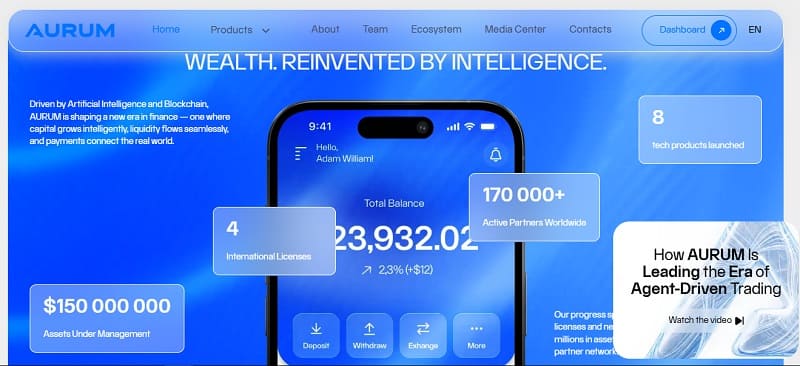
One of the most consistent themes across public discussions involves the difference between the balance displayed inside a user dashboard and the amount that can actually be withdrawn.
Former participants frequently describe a similar sequence. Initially, account values appear to increase steadily. Confidence grows as the dashboard reports continuing profits. The experience changes only when the first withdrawal request is submitted.
At that stage, users commonly report longer processing times, additional verification requirements or requests for further payments before funds can supposedly be released.
This distinction is important because an internal balance is not equivalent to independently verifiable assets held in reserve. Without transparent proof of reserves, audited financial statements or verifiable custody arrangements, figures displayed inside a private dashboard should not automatically be interpreted as evidence that equivalent funds are available for withdrawal.
| Claim Presented to Investors | Questions an Independent Reviewer May Ask |
|---|---|
| AI generates consistent monthly returns | Has the strategy been independently audited or verified? |
| Balances grow automatically over time | Can profits be withdrawn without additional conditions? |
| Institutional-grade technology powers the platform | Who developed the infrastructure and has it undergone external review? |
| Global financial ecosystem with multiple products | Which entities are licensed and by which regulators? |
| Community-driven wealth creation | Is revenue generated primarily through investing or through recruitment incentives? |

The Withdrawal Trap
Investigators often describe the final stage of investment fraud as a second monetisation phase. Instead of ending after the initial deposit, the operation continues by encouraging victims to send additional funds in order to recover money they already believe they own.
Reports concerning Aurum Foundation frequently mention requests for:
- compliance fees
- tax payments
- AML verification charges
- account activation costs
- liquidity confirmation
- withdrawal processing fees
Each payment is presented as the final step before funds can supposedly be released. Consumer protection agencies consistently warn that legitimate financial institutions do not normally require customers to pay advance "unlock" fees before releasing money already held in their own accounts.
An equally common follow-up risk is the recovery scam. After losing money, some victims are approached by individuals claiming they can recover stolen cryptocurrency through legal action, blockchain tracing or specialised techniques. These services frequently request another upfront payment before any work begins.
Also Read: From Fake Profits to Recovery Scams: The SW Alliance Investment Scheme Explained
The Expanding Domain Network
One characteristic shared by many large-scale online investment schemes is the gradual expansion of their digital infrastructure. Rather than relying on a single website, operators often create multiple domains, regional mirrors and separate portals.
Public records show that Aurum Foundation has been promoted through several domains over time. Among the primary addresses referenced by regulators and public investigations are:
| Domain | Purpose or Context |
|---|---|
| aurum.foundation | Main public website presenting the ecosystem |
| aurumfoundation.io | Domain referenced in regulatory warnings |
| backoffice.aurum.foundation | User dashboard and account management portal |
| aurum.trading | Trading website identified by the Hong Kong SFC |
| aurum-group.co / .info / .cc | Domains listed by the UK's FCA as clone websites impersonating an authorised firm |
| exiovip.site / exiovip.top / exiotop.click | Associated trading interfaces referenced by overseas regulators |
The appearance of multiple related domains does not automatically demonstrate wrongdoing. However, when different regulators independently associate several websites with the same operation, investigators often examine the broader infrastructure.
What Former Participants Report
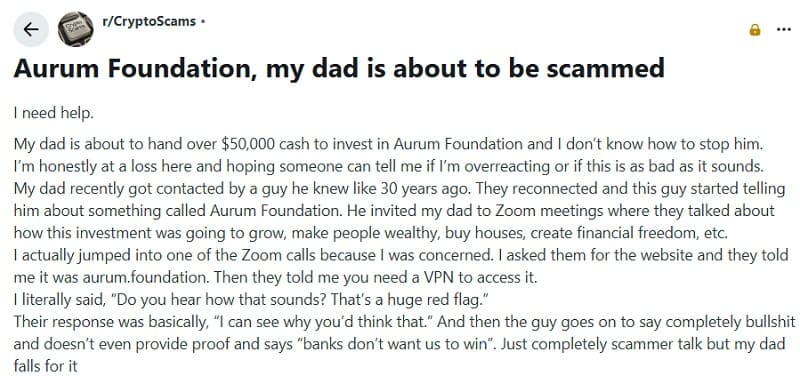
Across Reddit and other scam-awareness communities, users repeatedly describe a similar progression:
- initial emphasis on automated AI trading
- encouragement to introduce additional members
- dashboards displaying steadily increasing balances
- growing attention placed on referral structures rather than investment performance
- withdrawal requests met with delays or additional requirements
While individual online reports cannot independently establish misconduct, the consistency of these accounts mirrors concerns expressed by several financial authorities and investigative journalists.
Conclusion
Aurum Foundation illustrates how investment fraud has evolved. Rather than relying on simplistic promises or poorly designed websites, modern schemes increasingly adopt the appearance of technology companies. Artificial intelligence, digital banking, algorithmic trading and professional branding help create an image of innovation and credibility.
The public record surrounding Aurum tells a more complex story. Investigative reporting suggests that recruitment plays a far more significant role than public marketing implies. Consumer reports describe growing account balances followed by difficulties when attempting withdrawals. Meanwhile, regulators in several jurisdictions have issued independent warnings.
None of these elements alone is conclusive. Together, however, they present a consistent picture that prospective investors should examine carefully before transferring funds.
FAQ
Is Aurum Foundation regulated?
Several financial authorities have stated that entities associated with Aurum are not authorised to provide the services they advertise in their respective jurisdictions.
Why do many people compare Aurum to an MLM scheme?
Investigative reporting and participant accounts suggest that recruitment incentives receive significant attention during internal presentations, alongside referral structures and network growth.
Does a growing dashboard balance prove that profits exist?
No. Figures displayed inside a private platform should not be treated as independent proof that corresponding assets are available for withdrawal.
Why are additional withdrawal fees considered a warning sign?
Advance payments described as taxes, compliance charges or unlocking fees are frequently reported in investment fraud cases and are regularly highlighted by consumer protection agencies as a significant red flag.
Should victims pay another fee to recover their money?
Extreme caution is advised. Fraudsters often target previous victims with so-called recovery services that request further upfront payments.
How can investors verify a platform before depositing funds?
Check whether the company appears on official warning lists, confirm its licensing status with the relevant financial regulator and independently verify any corporate or registration claims.
Sources
- Hong Kong Securities and Futures Commission (SFC) — Alert List: Aurum / Aurum Foundation Limited
- Bank of Russia — Aurum Foundation (Signs of a Financial Pyramid)
- Financial Conduct Authority (UK) — Aurum Group Clone Firm Warning
- International Organization of Securities Commissions (IOSCO)
- Australian Securities & Investments Commission (MoneySmart) — Investor Alert List
- Reddit discussions
Need Help?
If you deposited funds with Aurum Foundation — drawn by promises of AI-driven wealth generation, "guaranteed" monthly returns, or referral bonuses for recruiting new members — and are now facing withdrawal restrictions, account freezes, or complete silence from the platform, you can request a free consultation with StockView specialists.
An expert review can help determine whether Aurum Foundation's structure aligns more with an MLM-driven Ponzi scheme than a legitimate investment fund, and realistically assess your chances of recovering lost funds through chargebacks, payment disputes, or coordinated legal action against the operators.
Get professional help with your case.