Vault Wealthholm Review: Inside the AI Deepfake Investment Scheme Using Fake Political Endorsements
- What Is Vault Wealthholm?
- How the Website Builds Credibility
- The Deepfake Campaign: Building Trust Before Asking for Money
- Fake News, Familiar Faces and Manufactured Credibility
- Why AI Changes the Economics of Investment Fraud
- Investor Experience: Where the Narrative Changes
- Regulatory Warnings
- How to Evaluate AI Investment Platforms
- Conclusion
- FAQ
- Sources
- Need Help?
Investment scams have grown far more sophisticated in recent years. Instead of relying on anonymous websites or obvious promises, many campaigns now combine artificial intelligence with professional branding and realistic media content. The goal is to create an environment that feels trustworthy before any financial decision is made.
The Vault Wealthholm campaign illustrates this shift clearly. Investigations found the platform was promoted through AI-generated videos falsely showing Australian politicians, alongside cloned news pages designed to look like established media outlets. Australia's financial regulator confirmed the service is not licensed to provide financial products in the country.

What Is Vault Wealthholm?
Unlike many short-lived crypto websites, Vault Wealthholm presents itself as a modern fintech service rather than a speculative scheme.
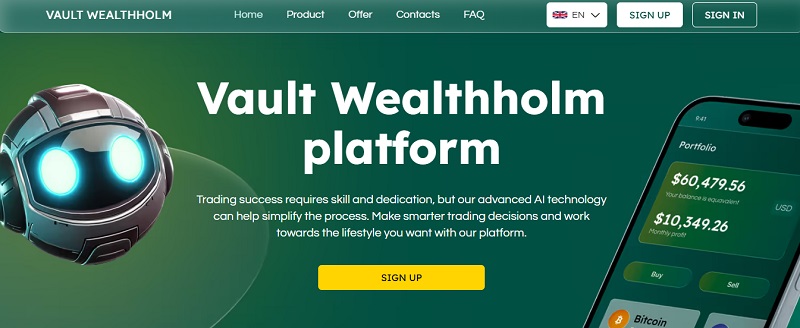
- The homepage vault-wealthholm.com emphasizes automation, market intelligence and ease of use. Visitors encounter concepts like machine learning and predictive analysis instead of aggressive promises of instant wealth. The presentation resembles a fintech startup more than a traditional brokerage.
- The advertised workflow is simple: complete a registration form, make a minimum deposit, receive assistance from trading specialists, let AI analyse opportunities and monitor performance through a dashboard.
- This messaging reflects a broader trend. Rather than claiming technology eliminates risk, promotional material emphasizes convenience. AI is presented as an analytical assistant capable of processing market data faster than individuals.
These concepts are not unusual. AI is widely used in legitimate financial services. The key question is whether the business provides sufficient evidence to support its claims.
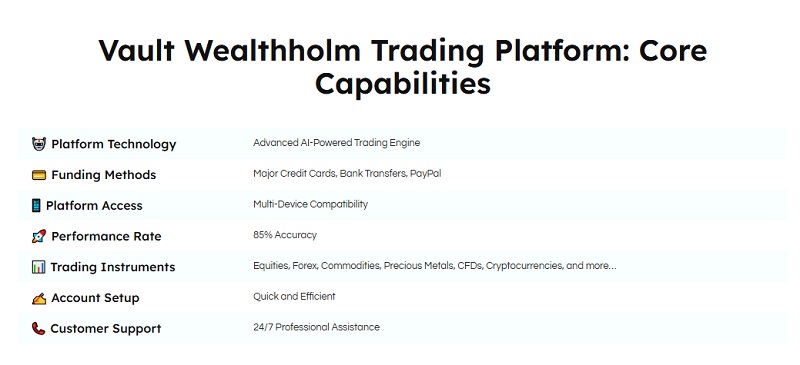
The website repeatedly references advanced AI, security infrastructure and regulatory compliance. It advertises an 85% trading accuracy rate and describes itself as fully regulated. Publicly accessible documentation verifying these claims was not readily available.
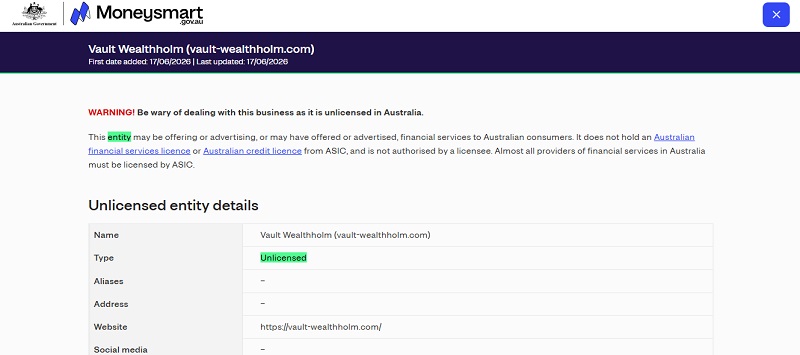
Regulatory information presents a different picture. ASIC's MoneySmart Investor Alert database lists Vault Wealthholm among businesses that do not hold an Australian Financial Services Licence.
How the Website Builds Credibility
Rather than relying on a single dramatic promise, the website layers numerous trust indicators throughout the user journey.
- Visitors see references to encrypted communications, two-factor authentication, educational resources, expert guidance, responsive support and modern design.
- Individually, these features are common across legitimate services. Collectively, they create a credibility environment where users evaluate visual professionalism rather than independently verifiable evidence.
The website devotes considerable space to algorithms and user experience. Far less emphasis is placed on corporate governance, executive leadership, audited results or independent compliance reviews. This imbalance matters because experienced investors assess transparency before evaluating technology.
| Website Representation | Publicly Verifiable Information |
|---|---|
| AI-powered automated trading | No independent technical validation identified |
| 85% trading accuracy | Not supported by audited reports |
| Fully regulated environment | ASIC states the entity is not licensed in Australia |
| Institutional-grade security | Independent certification not presented |
| Professional investment support | Corporate ownership remains less transparent than technical marketing |
The Deepfake Campaign: Building Trust Before Asking for Money
What makes this case unusual is not the investment offer but how victims were introduced to it.
Instead of directing users to a registration page, operators constructed a sequence resembling a genuine news event. Every step addressed the same question: "Why should I trust this?"
- The first contact came through sponsored social media posts. Users saw dramatic videos showing Australian politicians apparently arguing during a televised programme. The clips looked authentic but were entirely fabricated using AI.
- Rather than promoting financial products, the ads encouraged viewers to click and discover what happened. This is important. Earlier scams depended on greed. This campaign relied first on attention.
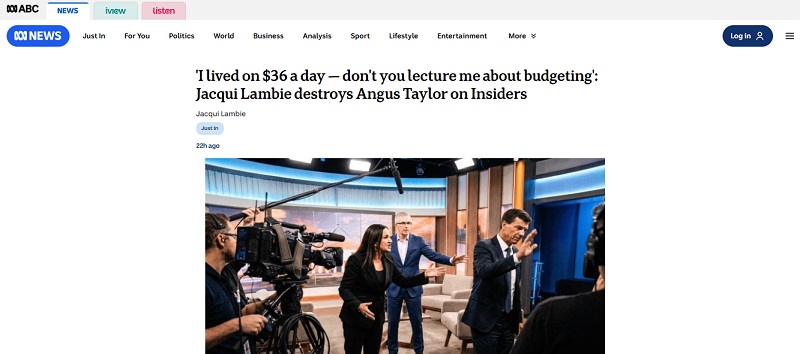
- Media investigations found the ads linked to pages designed to imitate ABC News. Logos, typography, layout and journalistic style were reproduced to create the impression of authentic reporting.
Also Read: How Scammers Use AI to Trick Crypto Investors
Fake News, Familiar Faces and Manufactured Credibility
The cloned article became the second recruitment stage. Instead of presenting Vault Wealthholm as unknown, it framed the platform as the subject of national political discussion. Readers encountered fabricated quotations from public officials alongside fictional reporting about an AI trading system.
Nothing encouraged users to question authenticity. Everything suggested someone else had already done the verification.
This reflects a major change in financial fraud. Older scams borrowed celebrity reputations. Newer campaigns borrow the credibility of entire institutions.
Several trust sources appeared simultaneously:
- recognisable politicians,
- a familiar television programme,
- a respected broadcaster,
- realistic news formatting and polished video.
Each supported the next. By the time readers reached the registration form, they had seen multiple signals suggesting legitimacy.
Investigators confirmed none of the political endorsements were genuine. The politicians never promoted the service. The broadcaster whose branding was copied publicly distanced itself from the campaign.
Why AI Changes the Economics of Investment Fraud
AI has not changed the psychology behind scams. It has changed production costs.
- A decade ago, creating convincing fake television footage required specialist software and significant resources. Today, these capabilities are available through commercially accessible tools.
- Criminals can now produce synthetic interviews, cloned broadcasts, realistic voice narration, fabricated testimonials and multilingual campaigns.
- These assets can be created repeatedly. Operators reuse infrastructure while replacing public figures, languages and media brands for different audiences.
- Deepfakes are increasingly used in financial fraud because they combine visual realism with emotional persuasion. Rather than asking users to believe an unfamiliar company, they encourage trust in faces and institutions already recognised.
People evaluate visual information quickly. A familiar politician, a recognised broadcaster, professional production quality — these signals are processed long before questions about licensing arise.
| Campaign Component | Psychological Function |
|---|---|
| AI-generated political videos | Capture attention using familiar public figures |
| Cloned news article | Transfer media credibility to unknown investment service |
| Fabricated quotations | Create illusion of political endorsement |
| Professional landing page | Maintain consistency between news story and registration |
| Follow-up adviser contact | Transform curiosity into financial commitment |
| Technical AI language | Shift attention from regulation and verification |

Investor Experience: Where the Narrative Changes
AI-themed investment campaigns typically have two very different phases.
- The first focuses on confidence. Registration is simple, the interface is polished and communication is frequent. Clients receive explanations about AI and market analytics rather than high-pressure sales.
- The second phase begins after money is transferred. Regulators describe a recurring pattern: account balances appear to increase, advisers encourage more deposits and dashboards show consistent performance. Because figures are generated within the operator's environment, they should not be treated as independent proof of profitable trading.
AI itself is rarely the mechanism through which losses occur. Instead, AI functions as a marketing narrative explaining why unusually strong performance remains possible.
Also Read: “Elon Musk” Crypto Casino Scam: A Forensic Breakdown of the $2,500 Bonus Trap
Regulatory Warnings
The strongest warning comes from Australia's financial regulator.
ASIC's MoneySmart Investor Alert List identifies Vault Wealthholm as a business without an Australian Financial Services Licence, not authorised to offer financial services in the country.
This directly contradicts promotional material on the website. The platform describes itself as regulated while emphasizing security and compliance, yet ASIC advises it is not licensed.
Authorities in other jurisdictions have also warned about campaigns combining AI-generated public figures, cloned news sites, fabricated interviews and follow-up calls from account managers.
| Regulatory Observation | Why It Matters |
|---|---|
| Platform appears on ASIC Investor Alert List | Not licensed to offer financial services in Australia |
| Deepfake political advertisements | Authorities warn these campaigns promote fraudulent platforms |
| Fake news websites | Transfer established media credibility to investment offers |
| Additional payment requests before withdrawals | Recurring warning sign in scam investigations |
How to Evaluate AI Investment Platforms
AI has become a common marketing term in online finance. Its presence alone indicates neither legitimacy nor fraud.
Legitimate institutions increasingly use machine learning for fraud detection and portfolio analysis. The key question is whether the business can be independently verified.
Before opening an account, consider these checks.
- Verify the regulator — not the website. Marketing pages often claim to be licensed. Confirmation should come from the financial authority, not promotional content.
- Separate technical language from evidence. Claims about predictive algorithms are difficult to evaluate without documentation. Independent audits carry more weight than marketing.
- Research the organisation. A legitimate business should provide clear information on corporate ownership, jurisdiction and executive leadership.
- Treat urgency with caution. Campaigns built around breaking news often seek to accelerate decisions before due diligence is complete.
- Ask if performance can be independently confirmed. Professional dashboards demonstrate software capability — not investment performance.
| Question to Ask | Why It Matters |
|---|---|
| Is the company licensed where it operates? | Official regulatory databases provide confirmation |
| Can reported performance be verified externally? | Internal dashboards alone are not evidence |
| Who owns and manages the business? | Transparent governance improves accountability |
| Does marketing rely on celebrity or political endorsements? | Promotions should never replace due diligence |
| Are technology claims supported by documentation? | Independent verification is more valuable than advertising |
Conclusion
Vault Wealthholm illustrates a broader transformation in online fraud rather than an isolated incident.
Earlier schemes depended on crude websites and unrealistic promises. Recent campaigns combine sophisticated branding, synthetic media and professional marketing that resemble legitimate fintech businesses.
Generative AI has accelerated this evolution. Deepfake videos, cloned news pages and automated content allow fraudsters to build convincing narratives at low cost. Visual credibility has become easier to manufacture than ever.
For investors, this changes risk assessment. Professional design and polished promotion cannot substitute for regulatory authorisation, transparent governance or independently verifiable evidence.
FAQ
Is Vault Wealthholm regulated?
ASIC's MoneySmart Investor Alert List shows Vault Wealthholm does not hold an Australian Financial Services Licence and is not authorised to offer financial services in Australia.
Did Australian politicians endorse the platform?
Media investigations found AI-generated videos falsely used public figures' likenesses. No evidence suggests genuine political endorsement.
Does AI trading automatically indicate a scam?
No. AI is used by legitimate financial institutions. What matters is whether claims can be independently verified.
Why are cloned news websites effective?
They borrow established media credibility, making unfamiliar investment offers appear trustworthy.
What should I verify before investing?
Check regulatory registration, corporate ownership, independent performance reporting and transparent documentation.
What should I do if I have already deposited funds?
Keep transaction records, save communications, stop sending additional money and report concerns to the financial regulator or cybercrime authority.
Sources
- ASIC MoneySmart Investor Alert List – Vault Wealthholm
- New Zealand FMA – Deepfake Video Scam Warning
- The Daily Telegraph – AI Deepfake Scam Using Australian Politicians
- Vault Wealthholm Official Website
- ASIC – Technology-Driven Consumer Harm Outlook 2026
- BaFin – Warning About Networks of Similar Investment Platforms
Need Help?
If you invested in Vault Wealthholm — convinced by AI-generated videos featuring political figures seemingly endorsing the platform, or by promises of AI-powered wealth management — and are now unable to withdraw your funds or suspect the entire operation was built on deepfake deception, you can request a free consultation with StockView specialists.
An expert review can help determine whether your case fits the emerging pattern of deepfake-driven investment fraud and realistically assess your chances of recovering lost funds through chargebacks, payment network disputes, or legal action against the operators behind this sophisticated scheme.
Get professional help with your case.