
The5ers Payout Complaints: What Traders Should Document Before a Compliance Review
- Why This Topic Has Become More Relevant
- The Industry Is Emphasising Verification
- Why Personal Records Outperform Platform Logs
- When Performance Is No Longer the Only Question
- A Public Example That Sparked Debate
- Understanding Trade Distribution Tools
- If Questions Arise After a Withdrawal Request
- A Broader Industry Trend
- Practical Takeaways
- Conclusion
- FAQ
- Sources
For years, prop firms competed on larger accounts, lower fees, and faster scaling. In 2026, conversations have shifted to what happens after generating profits — between a withdrawal request and actually receiving payment.
The5ers features prominently in these discussions. Thousands report successful withdrawals, while others describe delays, verification, or account closures. These individual reports don't prove any decision was right or wrong, but they raise a practical question: what evidence should traders already have if a review begins?
This article examines why documentation has become almost as important as trading performance itself.
Why This Topic Has Become More Relevant
Until recently, most prop firm content focused on passing evaluations. Today, traders increasingly discuss what happens after consistent profitability.
Recent Reddit discussions show recurring themes:
- withdrawal requests followed by temporary holds
- invitations to verification interviews
- questions about account ownership
- reviews of copier software
- requests for additional documentation
Not every trader reports the same experience. Many confirm verification was completed successfully. Nevertheless, growing discussions suggest compliance procedures have become more visible.

The Industry Is Emphasising Verification
A funded account differs from a standard brokerage account. Before releasing payments, many prop firms perform checks to confirm rules were followed and the requester is the actual trader.
This trend extends beyond any single company. Firms have introduced stronger identity checks, technical reviews and ownership confirmation.
According to The5ers' Terms, verification may include a video interview and identity documents. Interviews must be completed within five business days; otherwise payouts may be denied. These requirements form part of the published framework.
An interview request should not automatically be interpreted as evidence of rule violation.
| Verification Step | Purpose | Helpful Records |
|---|---|---|
| Identity confirmation | Verify the person behind the funded profile | KYC documents and previous verification emails |
| Platform review | Understand how positions were planned and executed | Trading journal, screenshots and platform history |
| Technical assessment | Review devices, IP history or execution environment | VPS records, hardware information and login history |
| Ownership assessment | Confirm independent control over user activity | Strategy notes and evidence of personal decision-making |
Why Personal Records Outperform Platform Logs
Most traders assume a complete trading history tells the whole story. Execution records answer only part of the question.
Platform logs show what happened, but rarely explain why. A reviewer may ask why a position was opened, why exposure changed, or why several accounts entered similar trades within seconds. Reconstructing these decisions from memory weeks later is difficult.
Contemporaneous notes, screenshots and risk records create an independent timeline. For many professionals, this is routine discipline.
When Performance Is No Longer the Only Question
A profitable track record remains the main objective. Yet once a withdrawal request reaches verification, the discussion may extend beyond charts.
Reviewers may seek to understand how decisions were made. Platform history provides timestamps but not always the reasoning. Many traders now keep personal records alongside their platform.
Also Read: Prop Trading Firms in 2026: Real Opportunity or a Model Designed for You to Fail?
A Public Example That Sparked Debate
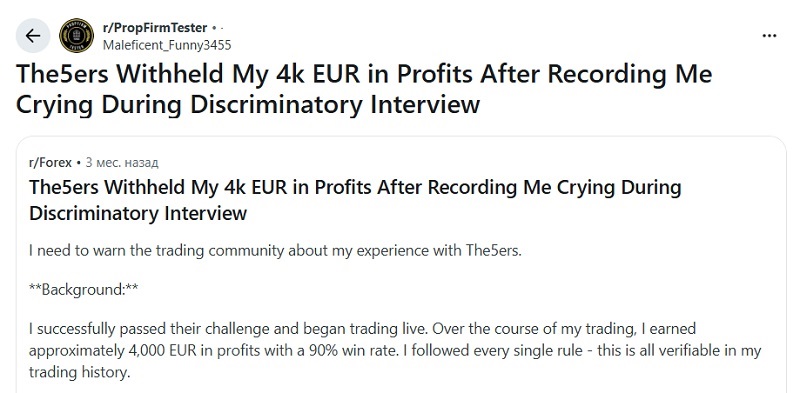
A widely discussed Reddit post illustrates why documentation has become a recurring topic.
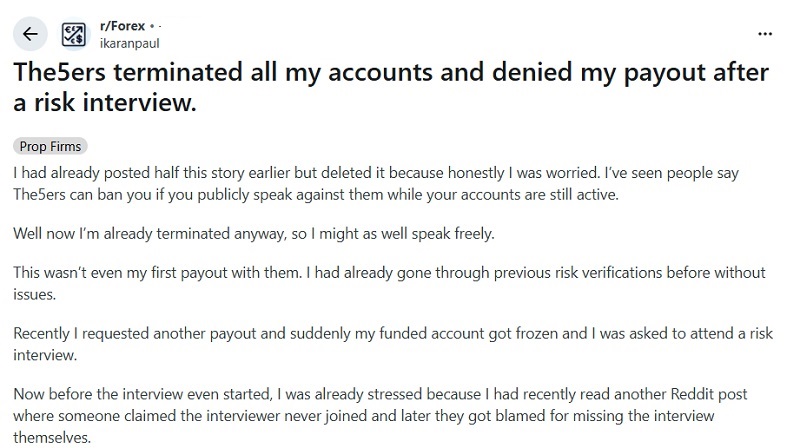
The author described submitting a withdrawal request after previous payouts. According to the post, access was suspended pending a video interview. The reviewer reportedly asked about methodology, execution, risk, devices, account structure and trade-distribution software.
The trader stated the setup relied on personally controlled profiles. Several days later, profiles were closed and the withdrawal declined. The explanation cited insufficient demonstration of independent trading knowledge. The trader disputed this, arguing the interview format made detailed answers difficult.
A single online account cannot establish whether an internal decision was justified. However, the discussion highlights a broader point: memory alone may not be enough.
Building a Useful Trading Archive
Many traders assume exporting platform history is sufficient. Execution logs answer only part of the story.
A reviewer may ask questions timestamps alone cannot answer:
- Why was this position opened?
- Why did exposure increase before news?
- What market conditions supported the entry?
- Why were several positions executed almost simultaneously?
- Which account generated the original signal?
These details are easier to explain if recorded when trades were placed.
| Record | What It Helps Demonstrate |
|---|---|
| Trading journal | The reasoning behind each position and risk decision |
| Platform history export | The sequence and timing of executed orders |
| Chart screenshots before entry | The market structure visible at the time of execution |
| TradingView layouts or notes | Technical analysis supporting the setup |
| Risk management plan | Consistency in position sizing and exposure |
| Email confirmations and support correspondence | A documented timeline of communications |
Understanding Trade Distribution Tools
Trade-copying technology frequently appears in discussions. Applications distributing orders across profiles are widely used. Their existence alone does not determine compliance. What matters is configuration and alignment with published rules.
The Terms state the company may request information, documents and a video interview during verification. Interviews may be recorded and must be completed within five business days.
Traders using execution infrastructure should retain records showing:
- where original orders originate
- which devices are used
- who owns each connected account
- whether any third party has access
If Questions Arise After a Withdrawal Request
Once a review starts, reconstructing weeks of activity from memory becomes difficult.
The instinctive reaction is often to focus on the final decision. A more productive approach is preserving everything that explains how the account was managed before the review.
This means keeping platform records and surrounding context — emails, verification history, trading notes and technical information.
| Information to Keep | Why It May Be Useful |
|---|---|
| Complete platform history | Shows the sequence and timing of executed trades |
| Trading journal | Explains why positions were opened or closed |
| Email correspondence | Documents requests, responses and deadlines |
| Verification records | Creates a timeline of KYC and identity checks |
| Chart screenshots | Preserves market conditions visible before execution |
| Technical setup information | Helps explain devices, VPS configuration and execution environment |
Another useful habit is saving the Terms version that applied when the plan was purchased. Firms periodically update policies. Retaining the version accepted at registration can clarify which framework governed the account.
A Broader Industry Trend
Although recent discussions frequently mention The5ers, stronger verification procedures are not unique to one company.
Across the industry, firms have introduced controls to detect profile sharing, coordinated activity, fraud and other breaches. As funded programmes become more competitive, validation has become normal risk management.
Public feedback reflects this mixed reality. The company maintains a high Trustpilot rating with many describing timely payments and straightforward verification. Meanwhile, some report disputes. Individual reviews represent personal experiences, but together they illustrate why record-keeping is increasingly recommended.
Also Read: From Fake Profits to Recovery Scams: The SW Alliance Investment Scheme Explained
Practical Takeaways
Whether trading with The5ers or another firm, a few habits can reduce uncertainty if verification is requested.
Before submitting a withdrawal request, consider:
- maintaining an up-to-date trading journal
- exporting platform history regularly
- saving important emails and support conversations
- documenting the trading setup and devices used
- retaining copies of applicable Terms
- responding to verification requests within deadlines
These steps don't determine outcomes. They can make it easier to explain how decisions were made and the account was operated.
Conclusion
The recent discussion surrounding The5ers reflects a broader change in the prop-trading industry. As firms emphasise verification, successful trading alone may not be the only factor considered.
For traders, the lesson is straightforward. Documentation should become part of the process from the start. A complete trading journal, organised records and a clear account history often provide stronger evidence than memory alone.
FAQ
Can a prop firm request additional verification before paying?
Yes. Many firms perform identity checks or request supporting information. The5ers' Terms expressly allow video interviews and documents during verification.
Does a video interview mean a rule violation?
No. Additional verification does not indicate misconduct. It is part of the published framework.
Is a trading journal necessary?
While not mandatory, it makes it easier to explain decisions if questions arise.
Should I keep copies of old Terms?
Yes. Saving the version that applied when an account was purchased can help establish which terms governed the relationship.
Are Reddit complaints proof of improper conduct?
No. Discussions provide context but represent individual experiences. Consider them alongside official policies and available evidence.
What is the main lesson?
Preparation matters. Maintaining records before requesting a withdrawal is easier than reconstructing events after a review begins.
Sources
Get professional help with your case.