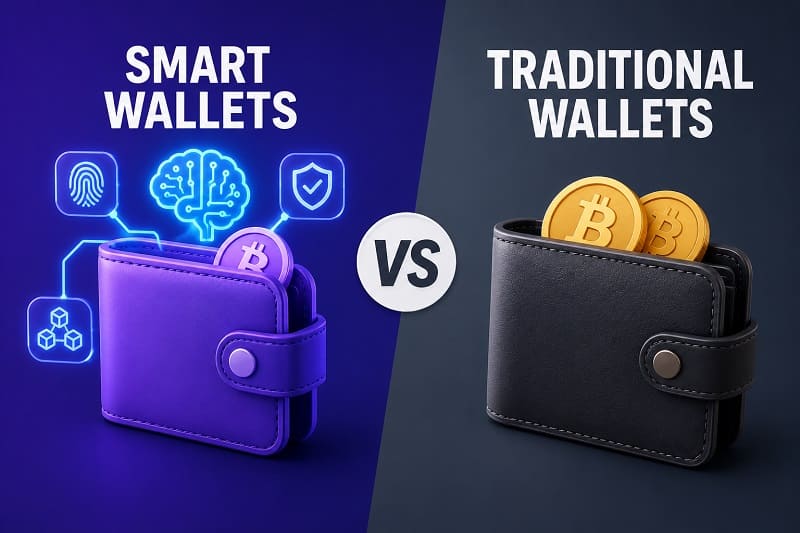
Smart Wallets vs Traditional Wallets: What's Actually Different?
- Why the Classic Model Has Started Showing Its Age
- A Different Way to Think About Digital Ownership
- Real-World Examples Already Available
- Account Abstraction: Why Everyone Is Talking About It
- Recovering Access Without Depending on Paper
- Why Paying Network Fees Is Becoming Less Complicated
- How Gas Abstraction Shifts the Onboarding Flow
- Programmable Permissions Replace "All or Nothing" Access
- Where Smart Accounts Make the Biggest Impact
- Why Traditional Wallets Are Not Going Away
- Choosing the Right Setup for Different Use Cases
- Final Thoughts
- Frequently Asked Questions
- Sources
For years, most people have interacted with blockchain networks through the same basic framework. A participant creates a cryptographic key pair, records a recovery phrase, signs transfers manually, and remains solely responsible for securing access to digital assets.
That setup helped decentralized finance grow, but it also introduced structural friction. Losing a seed phrase usually leads to permanent loss of capital, while a compromised key gives an attacker complete control within seconds.
Developers have long searched for a way to improve usability without sacrificing self-custody.
The result is a new generation of programmable accounts that move security and convenience features directly onto the blockchain through Account Abstraction. Rather than relying entirely on a single private key, these solutions allow validation rules to be defined by smart-contract code.
Today, this infrastructure is no longer experimental. Platforms such as Coinbase Smart Wallet, Safe, Argent, and several Layer-2 ecosystems already deploy smart accounts to simplify onboarding and reduce friction for everyday participants.

Why the Classic Model Has Started Showing Its Age
The first generation of crypto storage tools was intentionally minimalistic. One private key controlled one address. If the owner possessed the correct credentials, every operation could be authorized immediately.
This design remains highly secure when executed correctly. However, it places total operational burden on a single individual.
Consider a few common failure points:
- Accidental loss: Someone purchases a hardware device, writes the seed phrase on paper, and inadvertently discards it during a house move.
- Security breaches: An investor stores the backup in cloud storage, where it is later exposed through a phishing attack.
- Forgotten storage: A user simply forgets where the physical copy was hidden several years prior.
Although these situations differ, the outcome remains identical: access becomes impossible or funds are drained because there is no built-in fallback mechanism.
The same limitation appears during routine interactions.
Suppose a newcomer wants to exchange tokens on a decentralized exchange. Before completing the initial trade, they must install a browser extension, secure twelve or twenty-four seed words, acquire ETH to cover gas costs, and manually approve multiple network requests.
For experienced participants, this workflow is familiar. For someone accustomed to modern digital banking, it often feels needlessly complex.
Also Read: Wallet Backup Mistakes That Still Cost Crypto Users Millions
A Different Way to Think About Digital Ownership
Instead of forcing users to adapt to underlying blockchain mechanics, modern smart accounts make decentralization behave more like familiar web services.
The fundamental distinction is not where tokens reside. The real difference lies in how authority is verified.
A conventional address relies almost exclusively on one cryptographic signature. A programmable alternative allows custom rules to be written into the account itself.
Those conditions can include:
- requiring approval from multiple trusted devices;
- setting daily spending caps;
- granting temporary permissions for a specific dApp;
- restoring access via designated guardians;
- combining several network actions into a single confirmation.
Think of the distinction this way:
A physical key either unlocks the front door or it doesn't. A modern hotel key card can be configured to function only during specific hours, expire automatically, or grant access to selected rooms rather than the entire building.
The underlying purpose remains identical — granting access — but the operational rules become much more adaptable.
Ethereum's Account Abstraction initiative was designed specifically to unlock these capabilities while preserving decentralized ownership. Features like sponsored network gas, transaction batching, and flexible authentication become possible because validation logic moves into smart contracts rather than remaining hardcoded at the protocol level.

Real-World Examples Already Available
This architectural shift is no longer limited to technical whitepapers. Several established products demonstrate how programmable vaults operate in practice.
- Safe (formerly Gnosis Safe): Widely used by DAOs, investment funds, and Web3 organizations, Safe requires approvals from multiple team members before assets can be moved. Instead of granting full authority to one employee, a corporate treasury can enforce a 3-of-5 signature requirement.
- Coinbase Smart Wallet: Built around the ERC-4337 standard, this solution lets developers onboard users via passkeys while supporting gas sponsorship and bundled actions. Someone can interact with a dApp without purchasing ETH beforehand just to cover network fees.
- Web3 Gaming Platforms: Rather than requiring players to manage seed phrases before starting, a game can generate an account automatically during registration. The platform covers initial network gas behind the scenes, making the experience resemble signing into a standard web service.
None of these implementations alters the underlying consensus layer. Instead, they transform how people interact with it.
| Scenario | Conventional Approach | Programmable Approach |
|---|---|---|
| Lost recovery phrase | Assets may become permanently inaccessible. | Social recovery or alternative authentication may restore access. |
| First blockchain transaction | User must already own ETH for network fees. | An application can sponsor the initial transaction. |
| Multiple approvals | One private key authorises everything. | Several trusted participants can jointly approve operations. |
| Using a decentralised application | Several separate confirmations may be required. | Actions can be combined into a single user operation. |
| Temporary access | Sharing the private key is unsafe. | Limited permissions can be granted without exposing full control. |

Account Abstraction: Why Everyone Is Talking About It
At first glance, Account Abstraction sounds like an abstract engineering concept. In reality, most users experience its advantages without touching the underlying code.
Consider booking a vacation: Years ago, travelers visited a physical agency, filled out paperwork, and paid separately for flights, hotels, and transit. Today, a single mobile app bundles flights, accommodation, insurance, and digital passes into one transaction.
Smart accounts follow the same trajectory. Instead of forcing every dApp to follow a rigid signature process, developers define custom verification rules through code while the underlying chain ensures security. ERC-4337 introduced this model to Ethereum without requiring a hard fork, making features like transaction batching and gas sponsorship widely accessible.
For daily participants, that means fewer technical steps and a smoother onboarding experience.
Recovering Access Without Depending on Paper
One of the most persistent criticisms of early Web3 tools has been the absolute reliance on the recovery phrase. Anyone who loses those words permanently loses access to their balance.
That model maximizes self-sovereignty, but it creates a single point of failure.
Smart accounts offer alternative recovery paths. Instead of relying on one physical backup, access can be restored using pre-approved guardians or secondary devices:
- Lost Laptop
- New Device Request
- 2-of-3 Guardians Approve
- Access Restored
Imagine a freelance designer storing client payments in a crypto account. After losing a laptop while traveling, the traditional setup would require locating the original paper backup before moving any funds.
With a pre-configured recovery contract, the owner can authorize access restoration through two family members and a secondary mobile device. The address remains unchanged — only the signing authority is updated.
Argent pioneered this mechanism through its Guardian framework, while Safe allows organizations to distribute control across multiple signatories. ERC-4337 natively supports custom recovery logic because validation is governed by smart contracts rather than hardcoded protocol constraints.
Also Read: Wallet Recovery Services: Can They Really Help?
Why Paying Network Fees Is Becoming Less Complicated
Another major hurdle for newcomers appears before completing their first on-chain action: most networks require users to hold native tokens (like ETH) purely to pay gas fees.
This creates an awkward bottleneck. A user may hold stablecoins, yet remain unable to send a transfer because the balance contains zero native Ether.
Programmable accounts solve this via gas abstraction. Instead of requiring the end user to pay every fee directly, a third party can cover the cost or allow settlement in alternative assets.
How Gas Abstraction Shifts the Onboarding Flow
Traditional Model:
- Create Account
- Find Exchange
- Buy ETH
- Transfer ETH to Account
- Execute Desired Action
Sponsored Model (ERC-4337):
- Create Account
- Execute Desired Action (Paymaster Covers Gas)
Consider a gaming studio launching digital collectibles. Under the older system, every player needed to buy ETH before claiming a free item — a process where most non-crypto users dropped out. Under a sponsored model, the developer covers initial gas via a paymaster contract. The player claims the item instantly and decides later whether to purchase additional assets.
Coinbase Smart Wallet supports sponsored operations out of the box, while MetaMask's Smart Accounts toolkit enables developers to integrate similar gasless flows into their dApps.

Programmable Permissions Replace "All or Nothing" Access
Conventional blockchain addresses work in a binary fashion: either a dApp is granted full signature authority or it gets nothing.
While effective for basic transfers, this model is far from ideal for complex interactions. Connecting a yield aggregator that only needs to rebalance a portfolio once a week shouldn't require granting unlimited asset access.
Programmable permissions enable granular operational controls. An account holder can allow an application to:
- spend no more than $100 per day;
- interact exclusively with one verified protocol;
- execute automated recurring payments;
- operate only for a designated seven-day window;
- manage specific assets while leaving main holdings untouched.
MetaMask's Smart Accounts Kit uses delegated permissions to execute predefined tasks without exposing total balance control. These rights can be scoped by time, volume, or contract interaction.
Similar logic applies to AI-driven services. Instead of giving an autonomous agent unrestricted access to funds, a user can approve a single scoped task—such as swapping a fixed token amount every Friday or renewing a decentralized domain annually.
| Feature | Earlier Generation | Programmable Model |
|---|---|---|
| Recovery | Seed phrase only | Guardians, passkeys or custom recovery rules |
| Network fees | User must already own ETH | Developer sponsorship or alternative payment methods |
| Permissions | Broad approvals | Time limits, spending caps and application-specific rules |
| Multiple actions | Separate confirmations | Batch execution within one user operation |
| Real-world examples | MetaMask (classic mode), Ledger, Trezor | Safe, Coinbase Smart Wallet, Argent, MetaMask Smart Accounts |
These technical refinements don't replace the need for sound security habits. Instead, they give developers the flexibility to design Web3 interactions that feel as intuitive as modern online services.
Also Read: Agentic Crypto Wallets: Should You Let AI Sign Transactions for You
Where Smart Accounts Make the Biggest Impact
While technical discussions focus on underlying standards, the real value of Account Abstraction shows up in everyday use cases.
- Web3 Gaming
Mainstream adoption in gaming has long been hindered by complex onboarding. Smart accounts flip the sequence: players register using Face ID or a passkey, receive in-game items immediately, and let the developer sponsor initial gas fees behind the scenes.
- Digital Marketplaces
Rather than requiring first-time buyers to learn gas mechanics, platforms can bundle approvals and purchases into a single click, abstracting away technical steps.
- Automated Subscriptions
Paying for decentralized storage or SaaS tools previously required manual monthly signatures. Programmable accounts allow recurring transfers within strict spending caps, automatically rejecting unauthorized charges.

Why Traditional Wallets Are Not Going Away
Despite the rise of smart accounts, classic Externally Owned Accounts (EOAs) retain a firm place in the ecosystem.
Many experienced holders intentionally prefer the minimalism of an EOA:
- One key.
- One signature.
- Zero contract dependency.
This simple design minimizes smart-contract risk and has been battle-tested for over a decade. Hardware devices like Ledger and Trezor integrate seamlessly with this model, making them ideal for long-term cold storage where predictability outweighs convenience.
- Cold Storage / Hodl — Prefers EOA (Simple, minimal attack surface)
- Daily DeFi / Gaming — Prefers Smart Account (Passkeys, gas sponsorship, batching)
Similarly, while institutional treasuries benefit from multisig smart accounts, some funds still rely on legacy key-management setups built around hardware security modules (HSMs). The right choice ultimately depends on operational requirements rather than software trends.
Choosing the Right Setup for Different Use Cases
Industry adoption is accelerating. Coinbase Smart Wallet uses passkeys instead of seed phrases by default, while emerging protocols like EIP-7702 bring smart-account capabilities directly to existing EOAs without forcing users to migrate to a new address.
| User Type | Conventional Wallet | Programmable Account |
|---|---|---|
| Long-term investor | Excellent for simple asset storage with minimal complexity. | Useful only if additional recovery or automation features are desired. |
| Active DeFi participant | Works well but requires frequent manual confirmations. | Batch transactions and flexible permissions can improve efficiency. |
| Blockchain gamer | Initial setup may discourage new players. | Gas sponsorship and passkey login simplify onboarding. |
| DAO treasury | Requires external multisignature solutions. | Built-in programmable approval rules suit collaborative management. |
| Business accepting digital assets | Simple ownership model with direct control. | Can automate recurring payments, spending limits and delegated access. |
Final Thoughts
The goal of Account Abstraction is not to eliminate classic wallets, but to broaden the spectrum of user choices.
Conventional wallets remain a gold standard for cold storage, direct key ownership, and minimal code dependency. Programmable accounts, on the other hand, tackle the UX hurdles that have slowed broader adoption for years:
- recovery without paper backups;
- sponsored network fees;
- granular access rules;
- bundled executions;
- automated routines.
For someone holding Bitcoin or Ether offline for the next decade, a classic setup remains ideal. But for developers building consumer applications, gaming hubs, or payment systems, smart accounts provide the necessary infrastructure to make blockchain technology invisible to the end user.
Frequently Asked Questions
Are smart wallets more secure than traditional wallets?
Not inherently. They reduce human errors (like lost seed phrases) through social recovery and spending limits, but they introduce smart-contract code that must be thoroughly audited to prevent vulnerabilities.
Do I still maintain self-custody of my funds?
Yes. Programmable accounts remain fully self-custodial unless you explicitly use a third-party managed service. You control the rules governing signature validation.
Can I log in with passkeys instead of a recovery phrase?
Yes. Implementations like Coinbase Smart Wallet support passkey authentication (Face ID, Touch ID, hardware keys) natively via ERC-4337 standards.
Does gas abstraction mean network fees are gone?
No. Blockchain computation still requires gas. However, gas abstraction allows platforms or paymasters to cover those costs for you, or lets you pay using stablecoins instead of native tokens.
Which option is better for beginners?
Smart accounts offer a significantly easier onboarding experience thanks to passkey logins, social recovery, and sponsored gas. However, users interested purely in long-term asset storage may still prefer the straightforward setup of a classic cold-storage wallet.
Sources
Get professional help with your case.