Sertexity Review: Is This Project Legit or an Investment Scam?
- What Is the System Supposed to Do?
- Why Automated Trading Claims Need Careful Analysis
- Historical Profit Projections Raise Major Questions
- The SEC Filing Does Not Mean "SEC Approved"
- Rule 506(c) Is Not an Operating License
- Wisconsin Regulators Have Already Taken Action
- Comprehensive Risk Indicators
- The Company Is Extremely Young
- What About the $20 Million in Managed Assets?
- Discrepancies in Corporate Leadership
- General "Compliance" Language Needs Context
- Community Feedback and Public Discussions
- Why "Low Downside" Promises Are Particularly Problematic
- Essential Questions for Any Financial Protocol
- Practical Dangers for Account Holders
- Confirmed Facts vs. Unverified Assertions
- Final Verdict: Is the Project Legit?
- Guidance for Affected Users
- Frequently Asked Questions
- Sources
A recently launched automated asset system Sertexity claims users can obtain daily yields without managing trades directly. With an advertised onboarding threshold of just $50, the project promises low downside and rapid profit collection within 24 hours.
These marketing statements warrant careful scrutiny.
On July 1, 2026, the Wisconsin Department of Financial Institutions (WI DFI) issued an administrative summary order against Sertexity Labs, Inc., citing unregistered product sales and financial deceit. This state regulatory enforcement elevates the evaluation well beyond online speculation or anonymous forum commentary.
What Is the System Supposed to Do?
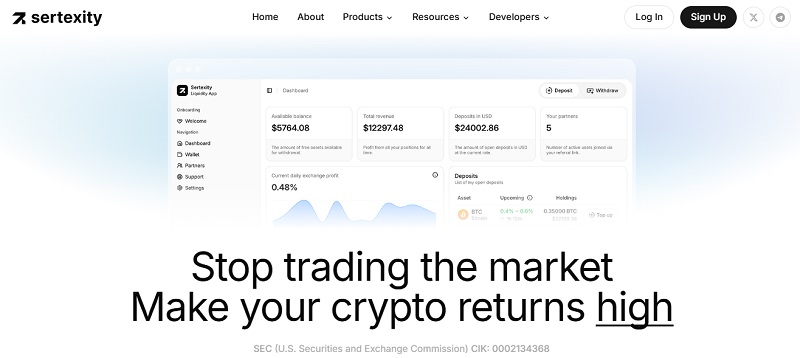
The operator describes its software as specialized financial infrastructure for retail participants rather than a conventional exchange venue.
According to public promotional materials, clients deposit capital into an automated pool, while proprietary "srtxboost" code captures cross-market fee margins. The creators assert this mechanism operates continuously regardless of broader price fluctuations.
The advertised onboarding workflow involves five steps:
- Create an account;
- Select a digital asset;
- Activate an automated pool;
- Run the trading system;
- Collect daily payouts.
The site highlights a low entry barrier and reports over 10,000 users, $20 million in managed funds, and $3 million in monthly distributions. These metrics reflect unverified operator assertions rather than audited accounting figures.
Why Automated Trading Claims Need Careful Analysis
Exploiting temporary price discrepancies for the same token across different markets is a recognized strategy. In standard execution, an operator attempts to profit when an asset trades slightly higher on one venue than another.
However, profitable operation requires navigating real execution friction:
- Exchange commissions and network gas fees;
- Order book slippage and illiquidity;
- Latency during wallet transfers;
- Withdrawal holds and daily limits;
- Counterparty issues across third-party venues;
- Competition from institutional market makers.
The CFTC regularly warns consumers against services marketing AI bots or automated software as guaranteed money generators. Regulators emphasize that algorithms cannot eliminate transfer costs or systemic market dangers.
Also Read: Crypto Arbitrage Scams: Why “Guaranteed Profit” Setups Are Fake
Historical Profit Projections Raise Major Questions
Earlier promotional collateral cited historical gains of 0.4% to 0.6% per operational cycle, framing losses as minimal due to advanced software controls.
Compounding these rates reveals the underlying financial problem. A constant 0.4% daily growth produces roughly 329% annually, while 0.6% translates to over 788% APY.
Real-world trading cannot function like a fixed-rate bond. Market spreads evaporate rapidly as capital increases, competition narrows price gaps, and execution costs consume margins. Any entity promising high distributions with negligible downside requires robust, third-party verification.

The SEC Filing Does Not Mean "SEC Approved"
A primary trust claim on the corporate portal is its display of a CIK identification number and references to Regulation D, Rule 506.
Public government databases clarify the exact nature of this submission:
| Legal Category | Official Filing Information |
|---|---|
| Issuer Entity | Sertexity Labs Inc. |
| Incorporation | Florida, USA (2026) |
| Principal Address | Miami, Florida |
| Named Officer | Evan Hartmore |
| Exemption Notice | Rule 506(c) of Regulation D |
| Offering Capital | Up to $5,000,000 USD |
| Reported Sales | $0.00 USD at submission |
Rule 506(c) allows private corporations to raise capital from accredited investors. The SEC explicitly states on Form D submissions that it does not review, verify, or approve the underlying business or financial safety. An exemption notice is a simple notification document, not an operating license or government endorsement.
Rule 506(c) Is Not an Operating License
A securities exemption regulates how a company raises private funding. It does not grant authorization to operate a retail exchange, run public liquidity pools, or custody client deposits.
Filing a Form D document does not transform a private firm into a licensed financial organization. The essential question is not whether an entity submitted a government notice, but whether it holds valid permits to manage public capital.
Wisconsin Regulators Have Already Taken Action
The most definitive warning regarding this entity comes from US state authorities.
The Wisconsin Department of Financial Institutions issued an administrative Summary Order on July 1, 2026 (Case S-252902 EX) against Sertexity Labs, Inc., classifying the violation under Unregistered Product and Fraud.
The agency's Investment Scam Tracker noted that the firm's advertised Florida address is linked to a shared commercial office suite. The entry further clarified that the entity's claimed SEC credentials were merely an unverified Form D notice.
Comprehensive Risk Indicators
| Parameter | Published Findings | Evaluation |
|---|---|---|
| Domain Lifecycle | Created December 3, 2025 | High Concern |
| SEC Credentials | Form D notice presented as approval | Misleading / High Concern |
| Enforcement | WI DFI Summary Order for Fraud / Unregistered Items | Critical Concern |
| Payout Promises | Automated passive income with low downside claims | High Concern |
| Minimum Capital | $50 starting threshold | Low entry barrier |
| Track Record | Incorporated in 2026 | Unproven operating history |
| Solvency Proof | No independent reserves or audit reports | Major Information Gap |
The Company Is Extremely Young
Domain records show that sertexity.com was registered on December 3, 2025. Corporate documentation confirms that the underlying firm was incorporated in Florida in early 2026.
Serious concerns arise when a newly formed entity claims over 10,000 active clients, $20 million in assets, and millions in monthly payouts within months of launch without providing independent cryptographic audits.
What About the $20 Million in Managed Assets?
Promotional materials claim the venue manages tens of millions in user capital, yet self-reported website numbers cannot replace an independent Proof of Reserves (PoR) report.
A transparent financial service should provide:
- Verifiable public wallet addresses;
- Reconciled balance attestations by accounting firms;
- Third-party smart contract security evaluations;
- Clear documentation of liquidity routing partners.
Isolated transaction feeds on a web page do not prove that customer balances correspond to actual reserve holdings.

Discrepancies in Corporate Leadership
The public team page lists profiles for individuals named Luis Gil, Evelyn Vargas, and Jose Uribe. However, official SEC filings name Evan Hartmore as the sole executive officer, director, and promoter.
This mismatch between public corporate filings and marketing materials represents a significant due-diligence red flag.
General "Compliance" Language Needs Context
Web pages for the service claim adherence to FATF, AML, and KYC frameworks, describing the operational model as "built on compliance."
General references to international standards do not replace official licenses. The Financial Action Task Force (FATF) is an international policy organization, not a licensing agency. Broad compliance slogans cannot override an active regulatory summary order.
Community Feedback and Public Discussions
Public forums contain numerous warnings regarding the venue, highlighting its young domain age, aggressive yield claims, and misleading SEC assertions.
While forum posts serve primarily as analytical leads, official state regulatory records now validate these community concerns.
Also Read: Legitimacy of WhiteBIT Exchange: Account Closures, Frozen Funds and User Complaints
Why "Low Downside" Promises Are Particularly Problematic
Regulators consistently warn against services advertising high, automated yields alongside minimal danger. In competitive financial markets, high distributions carry inherent exposure. Combining automated execution, passive daily returns, low downside, and no required experience is a classic signature of fraudulent schemes.
Essential Questions for Any Financial Protocol
A legitimate liquidity venue should transparently address basic operational mechanics:
- Spread Origins: Which specific markets supply the price discrepancies?
- Execution Latency: How is slippage managed during volatile periods?
- Loss Allocation: What protocol mechanism absorbs negative execution spreads?
- Fee Schedules: How are network gas and exchange commissions calculated?
- Custody Safeguards: Are user deposits stored in multi-signature cold wallets or audited smart contracts?
The absence of clear technical answers makes verifying the long-term sustainability of Sertexity difficult.
Practical Dangers for Account Holders
Traders evaluating or using the portal should keep these operational hazards in mind:
- Dashboard Disconnects: Accumulated dashboard profits do not guarantee that funds exist in reserve wallets.
- Secondary Fee Demands: Fraudulent yield schemes frequently request extra payments — framed as "verification fees" or "withdrawal taxes" — when users attempt to cash out.
- Withdrawal Restrictions: Initial small payouts do not prove an operator possesses liquidity to satisfy all user liabilities.
Confirmed Facts vs. Unverified Assertions
Confirmed Facts:
- Florida entity established in 2026;
- SEC Form D notice on record;
- WI DFI Summary Order concerning fraud.
Operator Claims:
- more than $20 million in managed assets,
- over 10,000 users,
- automated “low-risk” yields.
External Alerts:
- domain registered in December 2025,
- alongside negative community reports,
- a regulatory warning.

Final Verdict: Is the Project Legit?
Based on public data, Sertexity carries a critical risk profile, and investors should avoid depositing funds on the portal.
This evaluation is driven by an unproven corporate entity, unsustainable passive income claims, misleading presentation of a Form D notice, and an active summary order from the Wisconsin DFI citing fraud and unregistered product sales.
Guidance for Affected Users
If you have deposited funds with this provider:
- Refuse Additional Payments: Never send money to satisfy "withdrawal fees," "taxes," or "account unlocks."
- Preserve Documentation: Take screenshots of account dashboards, deposit wallet hashes (TxIDs), transaction histories, and support logs.
- Protect Credentials: Do not share private keys, seed phrases, or identity documents on public forums.
- Report to Authorities: Submit official complaints to state securities regulators, national financial authorities, or cybercrime units.
- Beware of Recovery Scams: Avoid third-party asset recovery services claiming they can retrieve lost digital assets for an upfront fee.
Frequently Asked Questions
Is Sertexity a legitimate trading venue?
No. Current regulatory evidence indicates high operational danger. The Wisconsin DFI issued an official summary order against the company for fraud and unregistered product sales.
Is the entity approved by federal regulators?
No. The firm merely filed an exempt Form D notice under Rule 506(c). Government agencies do not review, approve, or endorse entities that submit Form D filings.
What is Rule 506(c)?
Rule 506(c) of Regulation D is a US securities exemption allowing private firms to solicit accredited investors for capital raises. It is not an operating license.
Is market arbitrage inherently a scam?
No. Arbitrage is a standard trading strategy. However, platforms claiming to automate the process to deliver guaranteed daily distributions with low downside mirror the structures of fraudulent schemes.
How old is the official domain?
WHOIS records show that the domain was registered on December 3, 2025.
Sources
- U.S. SEC — Sertexity Labs Inc. Form D filing
- SEC — General Solicitation Under Rule 506(c)
- SEC — Exempt Offerings
- Wisconsin Department of Financial Institutions — Enforcement Administrative Orders
- Wisconsin DFI — Investment Scam Tracker
- CFTC — AI Trading Bots and Crypto Arbitrage Scam Warning
- CFTC — Fraudulent Digital Asset and Crypto Trading Websites
- CFTC — Risks of Virtual Currency Trading
- DomainTools — sertexity.com
- Reddit — Sertexity crypto arbitrage discussion
Get professional help with your case.