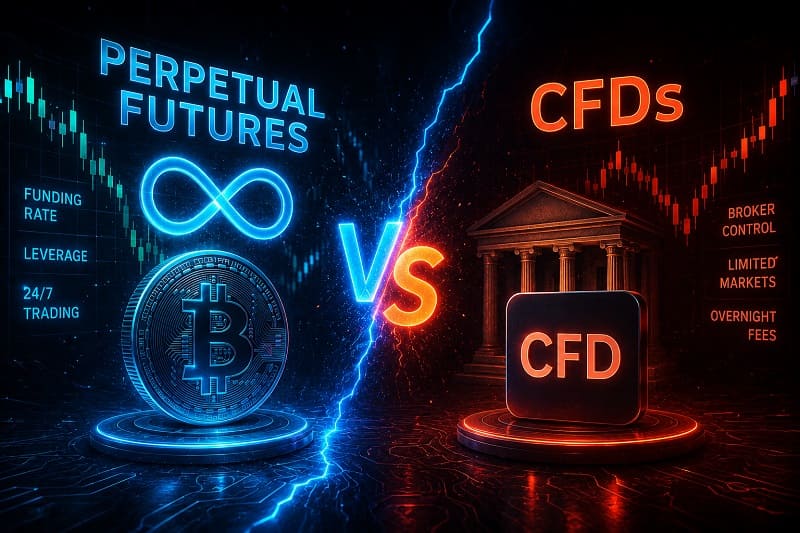
Perpetual Futures vs CFDs: Will Traditional Retail Brokers Survive?
- Why CFDs Became the Default Choice for Retail Trading
- The Cost of Convenience
- The Onshore Transition of Perpetual Futures
- Comparing the Two Frameworks
- Funding Rates vs. Overnight Financing
- Counterparty Risk: Who is on the Other Side?
- Are Perpetuals Moving Beyond Crypto?
- Where Traditional Intermediaries Still Hold the Advantage
- The Verdict: Will Retail Traders Still Need CFD Brokers?
- FAQ
- Sources
For decades, over-the-counter contracts for difference (CFDs) solved a simple problem: providing leveraged market access without requiring physical asset ownership or the administrative burden of managing expiry dates on traditional exchange-traded derivatives.
Today, this model faces a structural challenger. In May 2026, the US Commodity Futures Trading Commission (CFTC) approved KalshiEX’s BTCPERP — a regulated, cash-settled instrument tracking the spot price of bitcoin with no maturity date. Shortly after, regulators cleared the path for other domestic venues to strip expiration dates from their digital asset listings.
While this shift is currently unfolding in crypto, it points to a larger question: will retail traders continue to rely on traditional intermediaries once exchange-listed, never-expiring perpetuals expand to mainstream assets?

Why CFDs Became the Default Choice for Retail Trading
The rise of off-exchange retail trading is a story of operational simplicity. By shifting the trading environment to an over-the-counter (OTC) framework, brokers bypassed the hurdles of traditional investing:
- No physical friction: Speculating on gold did not require securing physical bullion.
- No basket complexity: Trading an index avoided buying fractional shares of dozens of companies.
- No settlement logistics: Foreign exchange transactions occurred without physical delivery.
Under this model, the provider issues a synthetic contract tracking a reference market. The client takes a directional position, and the payout is determined solely by the price difference between entry and exit, minus the broker's spread and financing fees.
[Retail Client] <--- Bilateral CFD Agreement ---> [Broker Platform] <--- Underlying Price
This setup hides the complex machinery of institutional markets. Traditional futures come with strict specifications, custody requirements, and manual rollover systems.
An OTC platform compresses this into a straightforward interface: select the asset, choose the leverage, and trade. This simplicity allowed brokers to build massive multi-asset platforms covering currencies, metals, and global equities.
The Cost of Convenience
This frictionless experience comes with ongoing structural costs. Regulators have long scrutinized the fee models of CFD platforms — particularly overnight financing (swap charges).
While these daily charges are negligible for short-term scalpers, they act as a heavy drag for swing traders holding positions over weeks or months. Daily interest charges quietly compound, eroding eventual gains. Yet, because traditional alternatives were highly complex, retail audiences accepted these costs for continuous market exposure.
The Onshore Transition of Perpetual Futures
Continuous, non-expiring derivatives first emerged as the primary trading vehicle on offshore, unregulated cryptocurrency platforms, solving a key usability pain point: giving active traders exposure to price movements without the headache of calendar-based rollovers.
The regulatory landscape in the United States shifted rapidly by mid-2026:
Offshore Crypto Venues (Unregulated) ---> Regulated US Exchanges (True Perpetual Futures)
In July 2025, Coinbase introduced regulated "perpetual-style" derivatives for US clients, structured as long-dated, five-year cash-settled agreements.
The real breakthrough arrived on May 29, 2026, when the CFTC approved Kalshi’s BTCPERP. This was classified as a genuine futures contract but carried no maturity date whatsoever. On June 12, 2026, regulators issued a key no-action letter allowing other domestic exchanges to convert their existing long-dated digital commodity listings into true, non-expiring instruments.
Licensed exchanges can now offer a product that directly replicates the core advantages of a rolling CFD:
- Directional, leveraged market access.
- No need to own or store the underlying asset.
- The complete elimination of manual contract rollovers.
- Seamless, continuous holding periods.
Also Read: The New Era of Crypto-Forex Hybrid Brokers

Comparing the Two Frameworks
These two structures achieve similar trading experiences through fundamentally different designs:
| Feature | CFD Model | Perpetual Futures Model |
|---|---|---|
| Contract Expiry | None (rolling cash structure) | None (true perpetual design) |
| Asset Ownership | None (synthetic price tracking) | None (cleared derivative) |
| Leverage Source | Provided via the broker's balance sheet | Managed through exchange margin systems |
| Carrying Mechanism | Overnight interest financing (swap fees) | Periodic funding rates matching longs and shorts |
| Execution Counterparty | Bilateral OTC contract directly with the broker | Listed order book on a regulated futures exchange |
| Price Alignment | Determined by broker price feeds | Maintained via systematic funding exchange between traders |
Funding Rates vs. Overnight Financing
The biggest technical challenge for any derivative without an expiry date is price alignment: if an instrument never settles, what stops its price from drifting away from the actual spot market?
Traditional futures solve this naturally; as the settlement date nears, the contract price converges with the spot price. Perpetuals maintain this link through a dynamic funding rate mechanism—periodic payments exchanged directly between long and short market participants.
- [Contract Price > Spot Price] ---> Longs pay Shorts (Encourages selling)
- [Contract Price < Spot Price] ---> Shorts pay Longs (Encourages buying)
This is a major departure from how CFD platforms charge for overnight positions:
- CFD financing is a one-way, administrative interest fee. The broker charges you a set rate (such as SOFR plus a commercial markup) for lending you capital.
- Perpetual funding is a two-way, market-driven balancing act. Depending on sentiment, a trader can actually receive payments for holding a position if they are trading against the dominant trend.
For retail clients, this creates entirely different dynamics. CFD holding costs are predictable but always negative. Under the exchange-listed model, holding costs are highly variable; maintaining a long position during an intense bull market can become expensive, while short sellers might earn passive cash flow simply for keeping trades open.
Counterparty Risk: Who is on the Other Side?
The structural difference between these two environments becomes clearest when analyzing who actually backs your trade.
[OTC CFD Model]:
- Retail Client <=============> CFD Broker (Principal / Market Maker)
[Exchange-Listed Model]:
- Retail Client <===> Clearing Broker <===> Central Clearinghouse <===> Market Liquidity
Most retail CFDs are traded over-the-counter. When you open a position, the broker acts as the direct counterparty (the principal) to your contract. While top-tier firms hedge this exposure externally, your legal agreement remains strictly bilateral with that specific provider.
Exchange-listed perpetuals operate on a completely different market architecture:
- Your orders are posted to an open, centralized ledger where you trade directly against other market participants.
- A central clearinghouse sits between all buyers and sellers, eliminating individual default risk.
- Price discovery is transparent and driven by organic order book depth, not a proprietary broker feed.

Are Perpetuals Moving Beyond Crypto?
Until recently, traditional brokerage firms could safely ignore the threat of exchange-listed perpetuals because they were confined to digital assets. That boundary is now beginning to blur.
In July 2026, financial media reported that leading exchange operators were in active discussions with US regulators to expand non-expiring contracts into traditional asset classes — specifically gold, foreign exchange, and major energy benchmarks.
If this expansion succeeds, exchange-listed perpetuals will begin competing directly for the core markets that drive retail broker revenues:
- Major currency pairs (EUR/USD, GBP/USD)
- Precious metals (Gold, Silver)
- Global stock indices (S&P 500, Nasdaq-100)
The main hurdle is adapting this model to storable physical commodities like crude oil, which carry real-world transport, logistics, and storage costs. If exchanges and regulators can successfully design a funding mechanism that accounts for these physical realities, the competitive landscape will shift permanently.
Also Read: Why Traders Are Obsessed With Gold (XAU/USD) in 2026
Where Traditional Intermediaries Still Hold the Advantage
Even if exchange-traded perpetual futures gain broad regulatory approval, traditional retail brokers possess a massive, highly optimized service and distribution network built over decades:
- Asset Variety: A single brokerage account routinely grants access to thousands of global shares, niche regional indices, and physical spot markets. Exchanges require immense, organic trading volume to keep a contract liquid, meaning they cannot easily support obscure or low-volume assets.
- Flexible Sizing: Retail brokers allow clients to trade highly customized, fractional contract sizes, making global markets accessible to those with modest account balances.
- Local Infrastructure: Established platforms offer localized payment methods, native-language support, and deeply integrated charting, research, and educational ecosystems.
- Consumer Protection: In regions like the UK and Europe, regulatory bodies mandate negative balance protection and strict leverage limits to protect retail users.
The Verdict: Will Retail Traders Still Need CFD Brokers?
Yes — but the relationship is changing.
Retail brokerages are not going to disappear, but they can no longer rely on "continuous, non-expiring leverage" as their sole competitive advantage. As regulated exchanges make true perpetual instruments available for mainstream assets, the technical uniqueness of the rolling OTC contract will diminish.
To stay competitive, brokers must transition from being simple contract issuers to high-value service aggregators:
- Focusing on ultra-low execution latency and razor-thin spreads.
- Offering seamless, unified access to highly diverse global markets.
- Developing superior mobile trading tools and advanced risk-management interfaces.
- Providing institutional-grade research and high-touch customer support.
The rise of regulated perpetuals doesn't make the brokerage business model obsolete—it simply forces it to evolve.
FAQ
Are perpetual futures the same as CFDs?
No. While both offer continuous, leveraged exposure without asset ownership, CFDs are bilateral OTC contracts traded directly against a broker. Perpetual futures are standardized, exchange-traded instruments matched on an open order book and backed by a central clearinghouse.
Do perpetual futures ever expire?
True perpetual contracts have no maturity date. Note that some older, exchange-listed products structured as "perpetual-style" actually have long-dated (e.g., 5-year) expiries, making them technically different from true, infinite perpetuals.
Is a funding rate identical to an overnight swap fee?
No. A CFD swap is a unilateral financing fee charged by the broker to maintain your leveraged position. A perpetual funding rate is a variable, market-driven mechanism where traders pay each other to keep the contract price in line with the spot market.
Will perpetual contracts expand to non-crypto markets?
It is highly likely. As of mid-2026, major exchanges are actively developing proposals to bring non-expiring contracts to gold, foreign exchange, and energy products.
Why are physical energy perpetuals difficult to design?
Unlike digital assets, physical commodities like crude oil involve real-world storage, transport constraints, and localized delivery points. Designing a non-expiring contract that reliably reflects these physical realities without a delivery month remains a complex regulatory challenge.
Sources
- Commodity Futures Trading Commission — Approval of KalshiEX BTCPERP Contract
- Policy Statement Concerning the Listing of Perpetual Contracts
- No-Action Letter Concerning Digital Commodity Perpetual-Style Futures
- Request for Comment on 24/7 Trading and Perpetual Contracts Referencing Energy Commodities
- Financial Conduct Authority — CFD Providers' Provision of Price and Value
- Reuters — Kalshi in Talks With Regulators to Expand Never-Expiring Derivatives to New Areas, July 9, 2026
- Chicago Mercantile Exchange Lawsuit Challenging CFTC Perpetual Futures Approvals, July 2026
Get professional help with your case.