
How Exchanges Track Suspicious Wallet Activity in 2026
- Why Exchanges Monitor Wallet Activity
- The Myth of Crypto Anonymity
- What Happens When You Send Funds to an Exchange?
- How Wallet Risk Scores Are Calculated
- Direct Exposure
- Indirect Exposure
- Behavioral Signals
- Wallet Clustering: The Technology Behind Blockchain Intelligence
- Red Flags That Commonly Trigger AML Alerts
- Why Legitimate Users Sometimes Get Flagged
- What Happens After an Address Is Flagged?
- Typical Escalation Path
- The Companies Powering Modern Blockchain Monitoring
- The Future of Crypto Compliance
- Conclusion
- FAQ
- Sources
- Need Help?
Many cryptocurrency users still believe that blockchain transactions are anonymous. The reality is far more complex.
Every transfer made on a public blockchain creates a permanent record. While wallet addresses do not automatically reveal a person's identity, modern compliance systems can analyze transaction histories, identify behavioral patterns, and estimate the risk associated with particular addresses. Today, most major exchanges screen incoming and outgoing transactions before allowing deposits, withdrawals, or other account activities. This process has become a core part of crypto compliance worldwide.
As regulators increase pressure on digital asset platforms, blockchain analytics has evolved into a multibillion-dollar industry. Companies such as Chainalysis, Elliptic, and TRM Labs provide tools that help exchanges identify potentially risky activity long before a human investigator reviews a case.
The result is a system where decisions are increasingly driven by risk scores, behavioral analysis, and transaction intelligence rather than simple identity verification.
Why Exchanges Monitor Wallet Activity
Crypto platforms operate under growing anti-money laundering obligations. Regulators expect exchanges to identify suspicious transactions, detect sanctions exposure, investigate potential fraud, and report high-risk activity when necessary. Failure to do so can result in substantial penalties and regulatory action.
As a result, monitoring systems have become standard infrastructure across the industry.
Most exchanges now evaluate:
- incoming deposits;
- outgoing transfers;
- transaction counterparties;
- cross-chain movements;
- behavioral anomalies;
- exposure to known illicit entities.
This monitoring often occurs automatically and within seconds of a transaction appearing on-chain.
The Myth of Crypto Anonymity
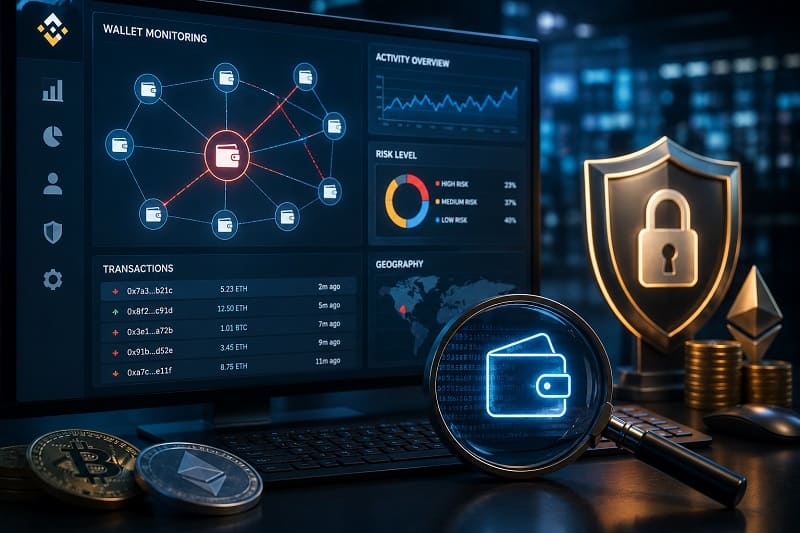
One of the biggest misconceptions in crypto is that transactions are invisible. In reality, Bitcoin, Ethereum, Solana, and most major blockchains are fully transparent. Every transfer can be viewed publicly. What analytics companies do is add context to that data.
Over time, researchers and compliance providers have built enormous attribution databases that connect blockchain addresses to real-world entities. These entities may include:
- exchanges;
- DeFi protocols;
- ransomware groups;
- darknet marketplaces;
- scam operations;
- sanctioned organizations;
- payment processors.
This process is known as wallet attribution. Once an address is associated with a particular entity, future transactions involving that address become easier to analyze.
In other words, exchanges rarely look at isolated transactions. They look at relationships.
What Happens When You Send Funds to an Exchange?
Most users imagine that a deposit simply arrives and is credited to their account. The actual process is far more sophisticated.
When a transaction reaches an exchange, the receiving address is typically screened automatically. The system analyzes where the assets came from, how they moved through the blockchain, and whether any known risk indicators appear in the transaction chain.
A simplified workflow looks like this:
- A deposit arrives.
- The transaction history is analyzed.
- Risk indicators are evaluated.
- A risk score is generated.
- Additional checks may be triggered.
- Human analysts review higher-risk cases.
Most deposits pass through this process without any visible impact on the user experience.

How Wallet Risk Scores Are Calculated
Risk scoring sits at the center of modern crypto compliance. Rather than labeling transactions as simply "good" or "bad," analytics systems evaluate multiple factors and assign a probability-based assessment.
Several categories typically influence the score.
Direct Exposure
This occurs when funds originate directly from a known high-risk source.
Examples include:
- ransomware wallets;
- sanctioned entities;
- stolen funds;
- darknet marketplaces.
Direct exposure generally receives the highest risk weighting.
Indirect Exposure
Not all risky transactions originate from criminal actors directly. Sometimes funds pass through several intermediate addresses before reaching a user.
Analytics systems frequently examine these transaction chains to determine whether there is indirect exposure to higher-risk activity.
Behavioral Signals
Modern monitoring tools increasingly focus on behavior rather than individual transactions.
Examples include:
- rapid movement between multiple addresses;
- unusual transaction velocity;
- repeated cross-chain transfers;
- interaction with mixing services;
- fragmented fund distribution patterns.
Research increasingly shows that behavioral analysis often provides stronger indicators than examining individual transfers alone.
Also Read: How Blockchain Analysis Helps Track Stolen Crypto Funds
Wallet Clustering: The Technology Behind Blockchain Intelligence
A single person can control hundreds or even thousands of blockchain addresses. This creates a challenge for investigators. To solve it, analytics companies use a technique known as clustering.
Rather than treating every address as independent, clustering algorithms attempt to identify groups of addresses likely controlled by the same entity. They examine transaction relationships, spending patterns, ownership indicators, and behavioral similarities. This allows analysts to see larger networks rather than isolated transactions.
For example, what appears to be ten unrelated addresses may actually belong to a single organization operating behind the scenes.
Without clustering, large-scale investigations would be significantly more difficult.
Red Flags That Commonly Trigger AML Alerts
While every compliance system is different, several factors consistently attract additional scrutiny.
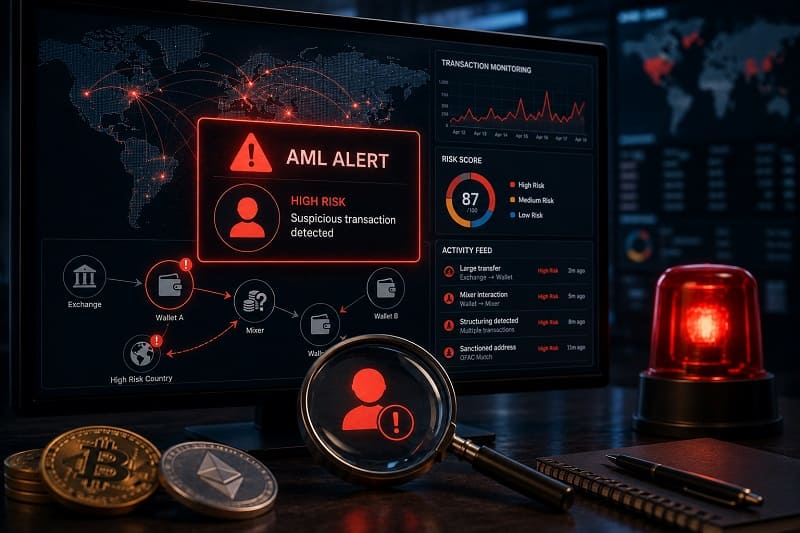
Common warning signs include:
- interaction with sanctioned entities;
- connections to stolen assets;
- exposure to ransomware payments;
- use of mixers or obfuscation services;
- links to known scam operations;
- unusual cross-chain activity;
- suspicious transaction patterns.
Importantly, the presence of one indicator does not automatically imply wrongdoing. Most systems are designed to identify elevated risk, not criminal intent.
Why Legitimate Users Sometimes Get Flagged
One of the most frustrating aspects of crypto compliance is that innocent users can occasionally become caught in monitoring systems.
This happens because risk models evaluate exposure rather than intent.
Consider several examples:
- receiving funds from a wallet that was later compromised;
- purchasing assets from a third party whose history contains problematic transactions;
- interacting with a protocol that later becomes associated with illicit activity;
- receiving assets that passed through high-risk addresses several transactions earlier.
In these situations, a user may face additional verification requests despite having no knowledge of the original source of funds. This is one reason why false positives remain a major challenge across the industry.
What Happens After an Address Is Flagged?
The outcome depends largely on the severity of the detected risk.
Typical Escalation Path
| Risk Level | Typical Response |
|---|---|
| Low | Transaction proceeds normally |
| Moderate | Additional monitoring |
| Elevated | Source-of-funds request |
| High | Enhanced due diligence |
| Critical | Potential restrictions or reporting |
Different exchanges use different thresholds, but the general framework remains similar across the industry.
Also Read: Crypto Wallet Trap Scams: Why Scammers Give You Access to Funds
The Companies Powering Modern Blockchain Monitoring
Most exchanges do not build sophisticated analytics infrastructure themselves. Instead, they rely on specialized providers.
The market is dominated by several major players:
| Provider | Primary Focus |
|---|---|
| Chainalysis | Transaction monitoring, investigations, sanctions screening |
| Elliptic | Risk scoring, attribution, compliance tools |
| TRM Labs | Cross-chain monitoring and behavioral detection |
| Crystal | Investigation and tracing tools |
| MistTrack | Risk analysis and stolen-fund tracking |
These platforms continuously analyze millions of transactions and update attribution databases as new threats emerge.

The Future of Crypto Compliance
The next generation of compliance systems is becoming increasingly sophisticated.
Artificial intelligence and machine learning are already being integrated into transaction monitoring frameworks. Instead of evaluating individual transactions in isolation, modern systems analyze broader behavioral patterns across multiple networks and time periods.
Academic research increasingly focuses on graph analysis, neural networks, and large-scale behavioral detection models capable of identifying suspicious structures within massive transaction networks.
The direction is clear. The industry is moving away from simple rule-based screening toward behavioral intelligence and predictive risk assessment.
Conclusion
Exchanges do not merely examine wallet balances or recent transfers.
Modern compliance systems analyze transaction histories, entity relationships, behavioral patterns, sanctions exposure, and broader on-chain activity. The goal is not necessarily to determine whether a user committed a crime. Instead, the objective is to identify potential risk before regulators, law enforcement agencies, or financial institutions become involved.
Understanding this distinction helps explain why some users receive additional verification requests even when they believe their activity is entirely legitimate.
In today's crypto ecosystem, the most important asset being evaluated is often not the transaction itself — but the risk profile surrounding it.
FAQ
Can exchanges see my wallet history?
Yes. Public blockchain transactions are visible to anyone, and exchanges commonly use analytics tools to evaluate transaction histories.
What is a wallet risk score?
It is an assessment generated by analytics systems based on transaction history, behavioral patterns, and exposure to higher-risk entities.
What makes an address suspicious?
Factors may include sanctions exposure, stolen-fund connections, ransomware activity, mixer usage, or unusual behavioral patterns.
Do exchanges use Chainalysis?
Many exchanges use Chainalysis or similar providers such as Elliptic and TRM Labs for monitoring and investigations.
Can a legitimate user get flagged?
Yes. False positives occur because systems evaluate risk exposure rather than intent.
What is wallet clustering?
It is a technique used to identify groups of addresses likely controlled by the same entity.
Are crypto transactions anonymous?
Most public blockchains are pseudonymous rather than anonymous. Transaction histories remain visible indefinitely.
What happens after an AML alert?
Additional monitoring, source-of-funds requests, enhanced due diligence, or other compliance procedures may follow.
Sources
- Chainalysis — Transaction Monitoring (KYT)
- Chainalysis — Blockchain Data Platform
- Elliptic — Blockchain Analytics & Compliance Solutions
- TRM Labs — Crypto AML and Compliance Resources
- Academic AML Research (RevTrack, StableAML)
Need Help?
If an exchange restricted your account after a deposit, withdrawal, or compliance investigation, understanding the transaction history may help explain what triggered the alert.
StockView specialists can assist with:
- blockchain transaction analysis;
- wallet-risk assessments;
- source-of-funds reviews;
- blockchain tracing investigations;
- exchange-compliance case analysis.
A professional review can often help identify whether restrictions were triggered by transaction exposure, historical address associations, sanctions screening, or automated risk-scoring systems.
Get professional help with your case.