Fake Compliance Departments: Why Scammers Pretend to Be Regulators
- Why a "Compliance Officer" Appears After a Withdrawal Request
- The Real Goal Is Another Payment
- Why Criminals Demand a "Tax" Before Releasing Funds
- Why the Narrative Continues to Shift
- How Legitimate Institutions Handle AML Reviews
- How to Spot a Fake Review Team
- Recommended Action Steps
- Conclusion
- FAQ
- Sources
- Need Help?
For years, fraudulent investment platforms relied on a simple tactic: convince users to deposit larger and larger sums. Today, many illicit venues keep operating long after a client submits a withdrawal request.
Instead of processing the payout, the platform abruptly shifts its tone. A new actor joins the communication channel, claiming to represent an internal review team or an external supervisory board.
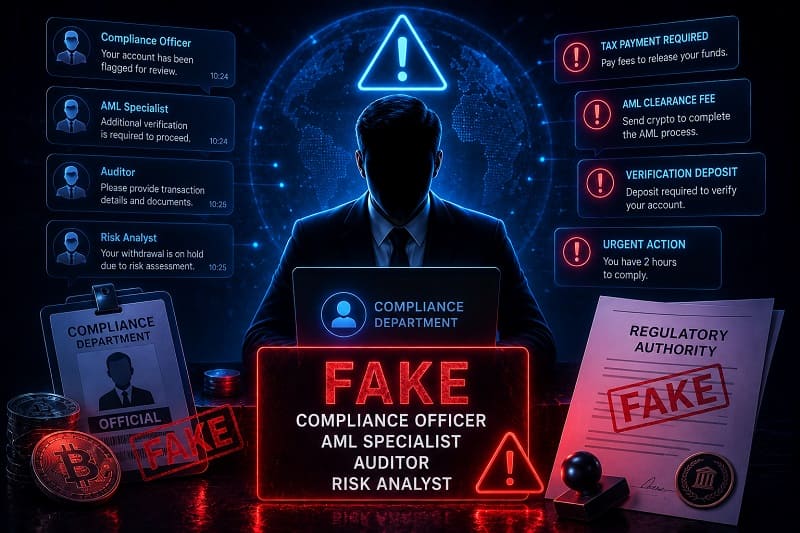
This newcomer may present themselves as a Compliance Officer, AML Specialist, Auditor, or Risk Analyst. Their appearance is carefully orchestrated to make the next financial demand appear formal rather than suspicious.
This additional persona serves a clear psychological purpose. Once individuals believe they are dealing with an official entity responsible for oversight, they are far more likely to accept unexpected demands prior to receiving their capital.
Consumer protection bodies frequently warn that bad actors impersonate regulators, supervisory boards, and public institutions to extract extra funds. Legitimate state agencies never demand cryptocurrency transfers or ask users to pay upfront fees to "unlock" account balances.

Why a "Compliance Officer" Appears After a Withdrawal Request
The sequence begins well before identity verification is ever mentioned.
In the initial phase, the platform encourages continuous deposits while displaying inflated account balances and fabricated trading gains. Everything changes the moment a user asks to withdraw funds.
Rather than executing the payout, support staff announce that the payout request requires secondary administrative checks. Shortly afterward, another contact reaches out directly.
This person claims to belong to a specialized unit overseeing anti-money laundering regulations, financial oversight, or transaction auditing.
Common titles assumed by fraudsters:
- Compliance Officer
- AML Department Specialist
- Financial Inspector
- Verification Manager
- Audit Representative
- Risk Management Director
Polished email templates, corporate badges, and official-looking credentials are frequently staged to build trust. Some operators go as far as crafting forged employment IDs or fake certificates linked to well-known institutions.
The objective is straightforward: clients follow instructions more readily when they assume an independent regulatory proxy — rather than basic customer support — is making the decision.
This approach mirrors broader impersonation fraud documented by regulatory watchdogs like the Federal Trade Commission, where bad actors leverage reputable brand names or official titles to gain trust before demanding capital.
The Real Goal Is Another Payment
Most investors expect an identity review to focus on submitted documents. Instead, the narrative rapidly shifts toward monetary obligations.
The supposed inspector explains that the payout cannot proceed until specific administrative conditions are fulfilled.
Typical requirements presented to victims:
- Advance tax clearance
- AML security deposit
- Account activation fee
- Temporary liquidity guarantee
- Network validation charge
- Wallet authentication payment
- Refundable reserve fund
The tone is almost always urgent. Clients are cautioned that failure to act could lead to frozen funds, canceled requests, or permanent account locks.
The language used is deliberately formal. Direct references to international legal frameworks, banking directives, or financial rules create the impression that the requirement stems from an outside authority rather than the platform itself.
In reality, authorized financial providers deduct legitimate fees directly from available user balances whenever applicable. They never mandate fresh crypto transfers simply to release existing funds. Consumer advocates emphasize that any demand for advance fees prior to a payout is a definitive red flag.
| Message Received | Underlying Objective |
|---|---|
| "Your request is undergoing a compliance review." | Creates the illusion of independent oversight. |
| "An AML check is currently required." | Introduces a legal pretext to delay processing. |
| "Tax settlement is required before release." | Attempts to justify an extra financial request. |
| "A refundable guarantee deposit is needed." | Encourages an additional cryptocurrency transfer. |
| "Your account has been temporarily flagged." | Applies psychological pressure to induce panic. |
| "Non-compliance will result in asset forfeiture." | Prevents the client from challenging the request. |
The introduction of an administrative specialist is rarely evidence of genuine processing. Instead, it signals a second operational phase aimed at siphoning more capital while keeping the victim convinced that their original funds remain recoverable.

Why Criminals Demand a "Tax" Before Releasing Funds
A clear sign of deception occurs when a platform insists on a new transfer before releasing an existing balance.
The justification often sounds plausible at first glance. A representative might claim that tax regulations require immediate fiscal settlement before capital can leave the venue. Others point to anti-money laundering checks or demand a temporary collateral deposit.
While the story varies, the core goal never changes: persuading the user to send additional capital.
This strategy matches the classic advance-fee fraud model highlighted by the U.S. Securities and Exchange Commission. In these setups, perpetrators insist that upfront charges must be cleared before proceeds can be released, even though no actual distribution will ever take place.
Frequently cited charges include:
- Fiscal clearance fees
- Anti-money laundering inspection charges
- Refundable security guarantees
- Wallet authentication fees
- Blockchain confirmation costs
- Cross-border clearing duties
- Account unlocking fees
Each requirement is framed as the single remaining hurdle. Regrettably, satisfying one demand almost always leads straight to another.
Also Read: Can You Detect an Investment Scam From the First 10 Messages
Why the Narrative Continues to Shift
Many users assume that making a single payment will finalize the process. Instead, the story constantly evolves.
Once a transaction is confirmed, the reviewer typically reports that an unexpected issue emerged during final verification.
Typical pretexts include:
- Incomplete paperwork
- High-risk transaction flags
- International transfer limits
- Secondary audit findings
- Updated regulatory guidelines
Each message is structured to make previous transfers seem necessary rather than wasted.
Psychologically, this tactic relies on the sunk-cost fallacy. Having already committed significant time and capital, victims feel compelled to continue because walking away means admitting that earlier payments are lost forever.
Supervisory bodies frequently warn that impersonation schemes rely on escalating requests rather than one-off demands. Fraudulent operators continuously invent new excuses to keep funds flowing while posing as reputable institutions.
Artificial urgency is another constant feature. Users are warned they have only a brief window before:
- Balances are frozen permanently
- Accounts are closed
- Legal proceedings begin
- Global reporting deadlines pass
Tight deadlines are meant to prevent independent verification. The less time a person takes to think, the less likely they are to spot the deception.
How Legitimate Institutions Handle AML Reviews
Authentic anti-money laundering protocols look nothing like the high-pressure tactics described above.
Regulated brokers, banks, and authorized digital asset platforms certainly conduct background verification and transaction monitoring. However, these activities operate within clear statutory frameworks — never through unannounced requests for crypto transfers.
When real providers require extra information, they request:
- Valid government-issued ID
- Proof of address
- Proof of source of funds
- Bank statements explaining specific activity
None of these procedures involve sending crypto to "unlock" an account.
If legitimate taxes or service fees apply, they are either deducted automatically according to signed agreements or settled directly with official tax authorities — never collected upfront by individuals messaging over Telegram, WhatsApp, or personal email.
Public watchdogs consistently state that official entities do not demand crypto, wire transfers, or prepaid cards to clear accounts or release funds.
| Fraudulent Claim | Authentic Industry Standard |
|---|---|
| "Pay taxes upfront to unlock your funds." | Tax obligations are settled with official revenue services or deducted automatically. |
| "Deposit a refundable guarantee." | Licensed venues do not demand extra crypto to process standard payouts. |
| "Send funds for AML clearance." | Compliance verification relies on documentation, not monetary deposits. |
| "You have two hours to comply." | Administrative reviews follow structured timelines, not artificial countdowns. |
| "Message this private contact directly." | Legitimate firms handle operations strictly through official support portals. |
| "A new fee is required due to audit findings." | Sequential financial demands indicate advance-fee exploitation. |
An expanding list of financial demands should be treated as a clear warning sign. Rather than proving that a real inspection is taking place, escalating requirements indicate an advance-fee scheme attempting to extract maximum value before cutting off contact.
How to Spot a Fake Review Team
Perpetrators put considerable effort into making their operations appear legitimate. Many victims note that the messages appeared formal, professional, and full of authentic legal terminology.
Fortunately, several distinct indicators appear consistently across these schemes.
Red flags to watch out for:
- Communication shifts unexpectedly from support agents to an unknown specialist
- Authoritative job titles appear without independent confirmation
- Outreach moves to Telegram, WhatsApp, or private email accounts
- New transfers are required as a condition for releasing existing capital
- Representatives cite confidential internal rules they claim cannot be detailed
- Strict deadlines are enforced to discourage independent checks
- Every completed step is followed by yet another demand for money
The communication channel itself provides crucial context. Regulated entities, public authorities, and official oversight bodies rely on verified institutional channels rather than anonymous messaging applications.
Official notices emphasize that legitimate staff do not reach out via messaging apps asking for money or sensitive account details. Staged ID cards and fake badges are routinely deployed to create a false sense of authority.
When urgency, secrecy, and repeated monetary demands intersect, immediate caution is necessary.
Also Read: Pig Butchering Scam: How It Works and How to Avoid It
Recommended Action Steps
The most effective step is to pause immediately before taking action. Urgency is the primary tool used to manipulate decisions in these situations.
Instead of complying with instructions, independently verify every detail.
Practical checklist:
- Stop sending additional funds
- Save all emails, chat histories, and transaction IDs
- Cross-check contact information using the firm’s main public website
- Search official regulatory registers to verify whether the individual actually exists
- Reach out to the organization using verified public phone numbers rather than provided links
- File a report with local financial consumer protection authorities
If transfers have already occurred, gathering documentation as early as possible can assist investigators in mapping out the transaction flow.
Investors should also watch out for follow-up schemes. After the primary operation ends, a different group may reach out claiming they can track and recover the lost capital for an upfront fee.
Regulators warn that recovery scams frequently target individuals who have already lost money, with fraudsters impersonating official personnel and promising asset retrieval in exchange for administrative fees.

Conclusion
Fabricated review departments have become a defining feature of modern investment fraud. Instead of cutting off communication right after denying a payout, organized groups introduce new personas with formal job titles to maintain the illusion of legitimate oversight.
Designations like Compliance Officer, AML Inspector, or Risk Auditor are chosen because they sound authoritative and minimize questioning. However, the objective remains unchanged: each new title provides a fresh excuse to ask for more money.
Whether the story involves tax settlement, identity checks, reserve deposits, or network validation, the core strategy is identical — convincing the victim that one final payment will release their capital.
Authentic financial institutions never demand fresh cryptocurrency transfers to release funds that already belong to the client. Recognizing this distinction is the most effective way to prevent financial loss and spot fraudulent operations early.
FAQ
Why do fraudsters introduce a "Compliance Officer" mid-way through?
Introducing a new role creates the appearance of independent administrative oversight. This makes subsequent demands look more legitimate than if they came from standard support staff.
Can a real AML check require sending additional cryptocurrency?
No. Genuine compliance checks rely on identity documentation, proof of address, and source-of-funds verification — never on advance payments.
Will paying the requested tax release my funds?
In advance-fee setups, making a payment leads to new excuses and demands rather than the release of your balance.
Do regulatory agencies contact investors via Telegram or WhatsApp?
No. Regulated public agencies and institutions communicate through official corporate channels. Staff do not contact individuals through private messaging apps to request funds or offer recovery services.
What should I do if someone claims to be a regulatory representative?
Break off contact, verify their identity independently through official public directories, and report any suspicious communication to relevant authorities.
Sources
- Federal Trade Commission — A Real FTC Employee Won't Text You Their Photo ID to "Verify" Their Identity
- Federal Trade Commission — FTC Data Show People Reported Losing $3.5 Billion to Imposter Scams in 2025
- Federal Trade Commission Office of Inspector General — Recognizing Scams
- Federal Trade Commission — Impersonator Scams
- European Commission (DG FISMA) — Beware of Scams Claiming to Be DG FISMA and Its Staff
Need Help?
If you were contacted by someone posing as a compliance officer, regulator, or financial authority — requesting personal documents, "verification fees," or even fund transfers to a "secure account" to resolve an issue with your brokerage or exchange — and you now suspect it was a fake compliance department running a sophisticated scam, you can request a free consultation with StockView specialists.
An expert review can help assess whether your case matches this emerging tactic of regulator impersonation and evaluate realistic options for recovering lost funds through chargebacks, payment disputes, or filing formal complaints with actual regulatory bodies.
Get professional help with your case.