
Is CriptoIntercambio a Scam? A Forensic Analysis of Complaints, Risks, and Swap Failures
- The Case That Raises the Question
- What CriptoIntercambio Actually Is
- Technical Profile: Legitimate Infrastructure, Conflicting Signals
- User Reviews: Pattern Recognition
- Funds Remain Locked After Transfer
- Post-Transaction KYC Requirements
- Ineffective Support Channels
- Partial Refunds and Fee Opacity
- Transaction Size Sensitivity
- Case Pattern Analysis
- How the Mechanism Works
- Why This Model Creates Structural Risk
- Industry Context: Not an Isolated Case
- So — Is CriptoIntercambio a Scam?
- Critical Conclusion
- Practical Takeaways
- Conclusion
- Need Help?
A crypto swap is typically presented as one of the simplest operations in the digital asset ecosystem. A user selects an asset, confirms the transaction, and expects to receive equivalent value on another network within a predictable timeframe.
However, this expectation breaks down when the process fails — particularly in cases where funds are successfully transferred out of a wallet, but the corresponding swap is never completed.
Over the past two years, a growing number of users have reported serious issues with CriptoIntercambio (CIC), a third-party swap provider integrated into wallets such as Exodus and Ledger.
This raises a critical question: are these isolated operational failures, or indicators of a structurally high-risk system?
The Case That Raises the Question
One widely discussed case involves a user attempting to swap approximately $280,000 in USDC across networks.
According to the report:
- the transaction was confirmed on-chain
- funds were successfully transferred from the wallet
- the swap process did not complete
- communication from support became non-responsive
Months later, the user continued receiving automated responses without any meaningful resolution.
This pattern is not isolated. Similar complaints appear across multiple platforms, often involving:
- high-value transactions
- prolonged processing delays
- funds remaining inaccessible for extended periods
What CriptoIntercambio Actually Is
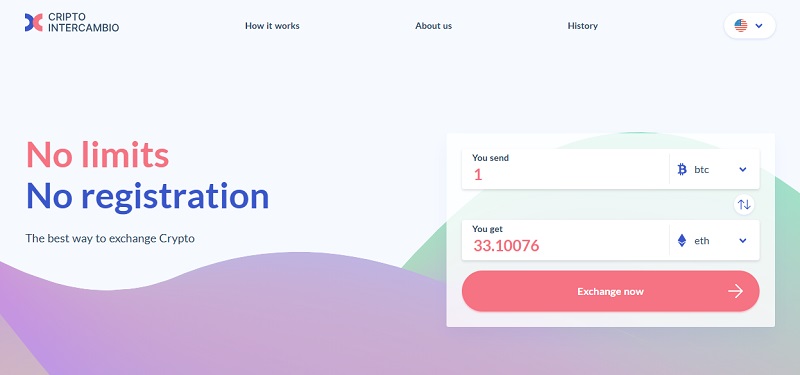
CriptoIntercambio (criptointercambio.com) does not operate as a traditional exchange.
Instead, it functions as:
- a third-party swap provider
- an intermediary routing transactions between liquidity sources
- a backend service integrated into non-custodial wallets
This distinction is essential.
When a user initiates a swap within wallets like Exodus or Ledger, the transaction is not executed by the wallet itself. Instead, the wallet transfers funds to an external service provider — in this case, CIC.
At that moment, control over the assets is no longer retained by the user.
Also Read: How Fake Crypto Exchanges Steal Funds
Technical Profile: Legitimate Infrastructure, Conflicting Signals
From a purely technical standpoint, CIC does not resemble a typical fraudulent website.
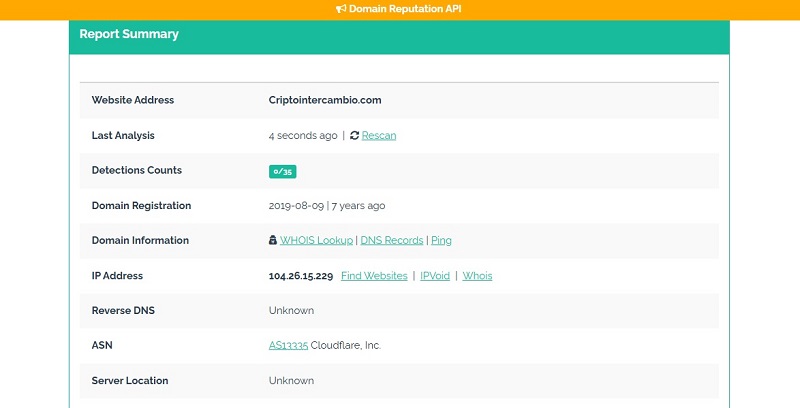
Domain and Infrastructure (DomainTools)
- operational since 2019
- updated — 2026-02-03
- uses Cloudflare infrastructure
- ownership masked via privacy services
- no malware detections in common scanners
- no phishing flags
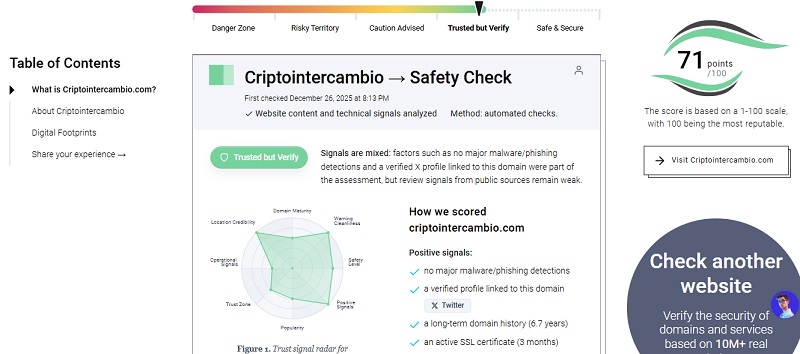
Reputation Metrics (GridinSoft)
- moderate trust score (~71/100 in some tools)
- classification often falls under “use with caution”
The platform appears technically legitimate and operational. However, infrastructure integrity does not necessarily reflect operational transparency or user safety.
User Reviews: Pattern Recognition
The most significant signal emerges from aggregated user feedback.
Across platforms such as Trustpilot:
- average rating: approximately 1.6 / 5
- majority of reviews: 1-star
- over 100 documented complaints
These reports demonstrate consistent behavioral patterns rather than isolated dissatisfaction.
Funds Remain Locked After Transfer
Users frequently report that:
- funds are successfully sent to the service
- transaction status remains in a pending state
- no clear timeframe for completion is provided
In some cases, assets remain inaccessible for months without resolution.
Post-Transaction KYC Requirements
A particularly concerning pattern involves identity verification requests appearing only after funds have already been transferred.
Although the service may initially present itself as not requiring registration, users later report being asked to submit:
- identity documents (passports or IDs)
- proof of source of funds
- additional verification data
This creates a structurally imbalanced situation: the service retains control over the assets, while the user is required to comply with verification demands under time pressure and without guarantees.
Ineffective Support Channels
Another recurring issue involves support responsiveness.
Users describe:
- receiving automated or template-based replies
- absence of escalation mechanisms
- lack of defined response timelines
In several documented cases, communication extends over months without resolution.
Partial Refunds and Fee Opacity
Some users report receiving partial refunds after extended delays. However, these refunds are often accompanied by:
- unexplained deductions
- inconsistent fee structures
- lack of transparent calculation methods
This introduces not only delay risk, but also financial unpredictability.
Transaction Size Sensitivity
One of the most analytically significant patterns is the difference in outcomes based on transaction size:
- small swaps are often processed successfully
- large swaps are more likely to be delayed, flagged, or frozen
This suggests that transaction handling is conditional rather than uniform.
Also Read: How to Avoid Phishing and Fake Crypto Websites

Case Pattern Analysis
Across multiple reports:
- A swap of approximately $280,000 remains unresolved.
- Around $50,000 in BTC has been frozen pending verification.
- Smaller swaps below $300 are typically completed without issues.Such inconsistency is not characteristic of purely technical failure.
Instead, it indicates a system where internal risk triggers influence transaction outcomes.
How the Mechanism Works
Understanding the architecture clarifies where risk emerges.
Step 1 — Swap Initiation
The user initiates a swap through a wallet interface. The process appears straightforward and controlled.
Step 2 — Transfer to External Custodian
The wallet sends funds to the service provider.
At this point:
- the transaction is irreversible on the blockchain
- the service becomes the temporary custodian of the assets
The user no longer has direct control over the funds.
Step 3 — Internal Processing
The service performs a combination of operations:
- routing through liquidity providers
- applying internal risk assessment or AML checks
- interacting with partner exchanges
These processes are not transparent to the user.
Step 4 — Risk Flagging and Intervention
If the transaction triggers internal risk parameters, the service may:
- pause processing
- request identity verification
- temporarily retain the funds
Importantly, these actions occur after the transfer has already taken place.
Step 5 — Outcome Variability
Depending on internal decisions, outcomes may include:
- successful swap completion
- delayed processing
- partial refund
- indefinite holding of funds
Why This Model Creates Structural Risk
Even without assuming malicious intent, the architecture introduces several systemic risks:
- Temporary Custodial Exposure. Users transfer control of their assets to a third party without enforceable guarantees.
- Undefined Processing Timelines. There are no transparent or binding deadlines for transaction completion.
- Asymmetric Power Dynamics. The service controls the assets, while the user must respond to requests without leverage.
- Limited Regulatory Visibility. There is no clear evidence of oversight comparable to regulated exchanges.

Industry Context: Not an Isolated Case
Research into crypto-related fraud and high-risk services indicates:
- thousands of suspicious or deceptive domains
- shared infrastructure patterns
- reliance on user trust in wallet-integrated interfaces
While CriptoIntercambio is not classified as a fake platform, it operates within a broader category of opaque intermediaries where risk is elevated.
So — Is CriptoIntercambio a Scam?
The answer is not binary.
What It Is NOT
- not a phishing site
- not a fake interface
- not malware
What It IS
- a real, functioning service
- operating with limited transparency
- associated with significant user complaints
- demonstrating inconsistent transaction outcomes
Critical Conclusion
In certain scenarios, user experience becomes functionally indistinguishable from fraud.
Not because the platform is necessarily fraudulent by design, but because users may lose control of their assets without predictable outcomes or enforceable protections.
Practical Takeaways
When evaluating CIC or similar providers:
- avoid high-value transactions
- assume temporary loss of control over funds
- verify the actual service provider, not just the wallet interface
- consider regulated exchanges such as Kraken or Coinbase for large transfers
Conclusion
CriptoIntercambio occupies a high-risk segment of the crypto infrastructure. It is not an obvious scam. However, it does not provide the level of transparency and predictability expected from secure financial systems.
In practice, the primary risk is not interacting with a fake platform, but transferring assets into a system where control, timelines, and outcomes are uncertain.
Need Help?
If your funds are currently stuck in a swap processed through a third-party provider, a transaction analysis can help reconstruct asset flows and assess whether any recovery options remain available. For a more detailed evaluation, consider reaching out to the specialists at Stock View.
Get professional help with your case.