BG Wealth Sharing & DSJEX: A 2026 Investigation Into a “Signals” Platform Flagged by Regulators
- What BG Wealth Sharing Claims to Be
- The Legal Reality Behind the Brand
- How the Scheme Works in Practice
- Why It Feels Legitimate
- No Single “Official” Website: A Structural Red Flag
- Trustpilot Reviews: What the Patterns Suggest
- Regulatory Warnings Across Jurisdictions
- Key Red Flags
- What to Do If You’re Already Involved
- Can Funds Be Recovered?
- Conclusion
- Need Help?
A friend reaches out. There’s a private group, a “professor,” and a simple routine: paste a code twice a day, risk just 1% per trade, and watch your balance grow. Some people even show small withdrawals as proof.
That’s how many users first encounter BG Wealth Sharing and the related “exchange” ecosystem commonly referred to as DSJEX.
In 2025–2026, this setup has attracted attention not only on forums — but from multiple financial regulators. What follows is a structured, evidence-based look at how the model works, what’s known about its legal footprint, and why it raises consistent red flags.
What BG Wealth Sharing Claims to Be
Promoters present BG Wealth as an investment community built around:
- short-term “signals” (often 60-second futures-style trades)
- low per-trade risk (commonly framed as ~1% of capital)
- extremely high win rates (often advertised as near-perfect)
- a simple, repeatable routine delivered via chat apps
Users are typically guided to:
- Join a private chat (often BonChat/WhatsApp-like)
- Deposit funds via a mainstream on-ramp (e.g., Coinbase)
- Transfer crypto to a partner “exchange” (DSJ-branded sites)
- Paste a code at specific times to execute trades
The pitch emphasizes consistency and simplicity — two traits that strongly reduce skepticism in beginners.
The Legal Reality Behind the Brand
A key part of the confusion is that BG Wealth Sharing appears to have fragments of a regulatory footprint — but not in the way users assume.
- A U.S. record exists for BG WEALTH SHARING LTD in the SEC’s Investment Adviser Public Disclosure (IAPD) system (CRD #338316; SEC file 802-134353), associated with the name Stephen Beard. Important: this reflects a filing status (including Exempt Reporting Adviser categories) and does not equal SEC approval or endorsement.
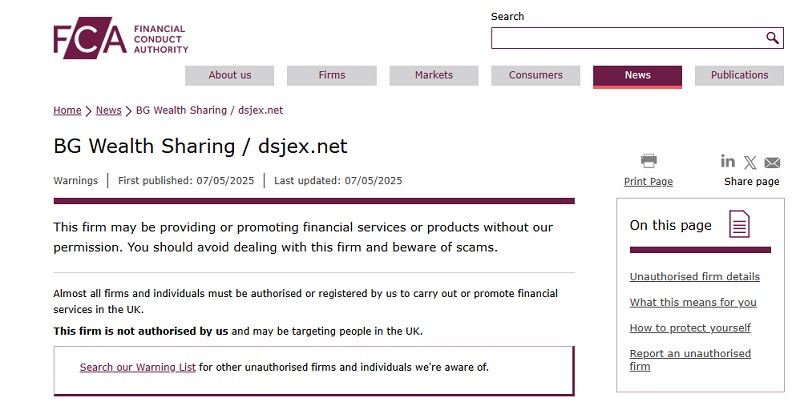
- The Financial Conduct Authority has issued a warning tied to BG Wealth Sharing / dsjex-related domains, noting that firms may provide misleading contact details and appear more credible than they are.
- Canadian regulators, including the Alberta Securities Commission and the British Columbia Securities Commission, have stated that BG Wealth Sharing Ltd. is not registered to trade or advise in their jurisdictions.
- U.S. state-level alerts (e.g., Washington State DFI, Utah Division of Securities) describe concerns about representations, addresses, and registration status, emphasizing that investors should not rely on claimed affiliations.
- The Financial Markets Authority (with the National Reserve Bank of Tonga) warned that schemes linked to BG Wealth / DSJ EX operate via messaging apps, promise extreme returns, and may be part of a large, rotating network of domains and entities.
Bottom line: there is no clear, consistently verifiable licensing framework supporting the trading claims being marketed to users.
How the Scheme Works in Practice
Across independent reports, a consistent pattern emerges:
- Social entry point. Recruitment usually happens through a trusted contact — friend, colleague, or family member — lowering initial resistance.
- Authority layer. A “professor” figure and assistant deliver signals. Titles create perceived expertise even when identities are not independently verifiable.
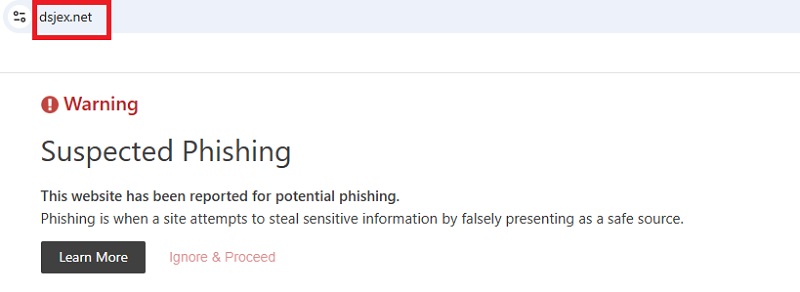
- Platform redirection. Users are instructed to move funds to DSJ-branded websites such as:
- dsjex.net
- dsjzn.com
- dsj011.com
- dsjj.net (variants appear over time)
- Code-based trading. At fixed times, a short code is pasted. The interface shows quick trades and frequent wins, reinforcing belief in the system.
- Controlled withdrawals. Some users report small early withdrawals — consistent with a trust-building phase seen in many scams.
- Friction phase. Larger withdrawals trigger:
- fees (often ~12%)
- penalties (e.g., early withdrawal charges up to ~20%)
- requests for additional deposits to “unlock” funds
- Expansion pressure. Users are encouraged to invite others, unlocking “levels,” “salary,” or bonuses — an MLM-like layer.
The structure blends signals trading + gated withdrawals + referral incentives, which together can sustain the system until inflows slow.
Why It Feels Legitimate
The setup is engineered to look real:
- Familiar rails: deposits start from known platforms (e.g., Coinbase), then move to a second site.
- Visible activity: dashboards show trades, balances, and PnL updates.
- Routine: fixed-time signals mimic disciplined trading.
- Early wins: small withdrawals can be allowed to prove functionality.
- Social proof: group chats filled with testimonials and screenshots.
Psychologically, this replaces doubt with habit. By the time friction appears, users are already invested — financially and socially.
No Single “Official” Website: A Structural Red Flag
Unlike established financial firms, BG Wealth does not operate from a single stable domain.
Observed domains include:
- bg662.com
- bg661.com, bg877.com (variants reported by users)
- bgwsig.com (presented as an “official” site in some contexts)
- DSJ-related domains: dsjex.net, dsjzn.com, and others
This domain rotation matters. Legitimate brokers and exchanges maintain:
- one primary domain
- consistent branding
- verifiable ownership and licensing pages
A shifting domain footprint is typical of operations that need to evade blocks, rebrand quickly, or fragment visibility.
Trustpilot Reviews: What the Patterns Suggest
There isn’t a single unified Trustpilot page — reviews are scattered across multiple domains (e.g., bgwealthsharingltd.com, bgwealthgroup.com, bgwsig.com).
Positive reviews often:
- emphasize fast profits and mentorship
- use similar phrasing and tone
- focus on lifestyle outcomes rather than product mechanics
Negative reviews are typically more detailed, citing:
- inability to withdraw without extra payments
- escalating fees or “verification” charges
- pressure to recruit
- communication breakdown once larger sums are involved
Trustpilot itself does not fact-check every claim; it uses automated moderation and flags suspicious patterns. The polarization (very high vs very low ratings) — especially across multiple domains — suggests a contested reputation rather than a stable service record.
Regulatory Warnings Across Jurisdictions
Multiple authorities have issued alerts tied to BG Wealth Sharing / DSJEX:
- Financial Conduct Authority — warning on BG Wealth Sharing / dsjex-related activity
- Alberta Securities Commission — not registered; investor alert
- British Columbia Securities Commission — not registered in BC
- U.S. state alerts (Washington DFI, Utah Division of Securities) — concerns about representations and registration
- Financial Markets Authority — describes messaging-app-based promotion, extreme return promises, and a broader network model
A consistent theme across these notices is lack of registration, misleading claims, and high-risk characteristics.
Key Red Flags
Individually, some elements might appear benign. Together, they form a high-risk profile:
- Near-guaranteed returns (e.g., ~99% win rates)
- Short-term doubling timelines (e.g., ~55–60 days)
- Fees/penalties to withdraw — especially before hitting targets
- Recruitment bonuses framed as “salary”
- Unverifiable leadership identities
- Messaging apps with limited audit trails (e.g., BonChat-like environments)
- Multiple rotating domains and exchange endpoints
- Regulatory warnings and lack of licensing
What to Do If You’re Already Involved
If you or someone close to you is participating:
- Stop sending additional funds, including “release” or “verification” fees
- Document everything: chat logs, TXIDs, wallet addresses, domains, timestamps
- Check official warnings in your jurisdiction and follow reporting channels
- Contact your on-ramp/exchange (where the initial transfer was made) with transaction details
- Be cautious of “recovery agents” asking for upfront fees — these are often secondary scams
Can Funds Be Recovered?
Recovery is challenging, but not always impossible.
Outcomes depend on:
- how quickly action is taken
- whether funds passed through a centralized exchange (where freezing is possible)
- the quality of transaction tracing and documentation
Early escalation — paired with complete records — can improve the odds, even if success is never guaranteed.

Conclusion
BG Wealth / DSJEX is not a single website or a simple app. It’s a multi-layered system combining:
- signals-based trading narratives
- gated withdrawal mechanics
- referral-driven growth
- and a rotating web presence
When assessed against regulatory guidance and real-world patterns, the risk profile is clear.
The critical mistake isn’t failing to follow a signal — it’s trusting a structure that controls deposits, execution, and withdrawals without transparent, verifiable oversight.
Need Help?
If you lost money to BG Wealth Sharing or are trying to exit the scheme, recovery may still be possible in some cases — especially if action is taken quickly.
You can request a free consultation with the Stock View team to review your situation and possible next steps.
Get professional help with your case.