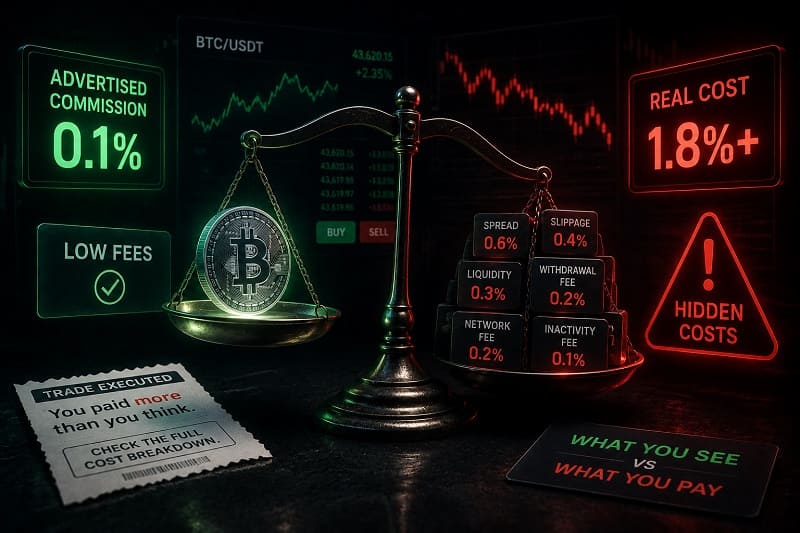
The Real Price of a Crypto Trade: Why a Low Commission Can Be Misleading
- The Number on the Pricing Page Is Only a Starting Point
- Three Different Things That Change the Final Price
- A “Buy” Button Can Lead to Several Different Products
- Why “Zero” Does Not Always Mean Nothing Is Paid
- Small Transfers Often Reveal the Bigger Problem
- The Exit Matters Before the Purchase Is Made
- A More Useful Comparison Method
- Common Errors That Make a “Cheap” Trade Expensive
- Conclusion
- FAQ
- Sources
- Need Help?
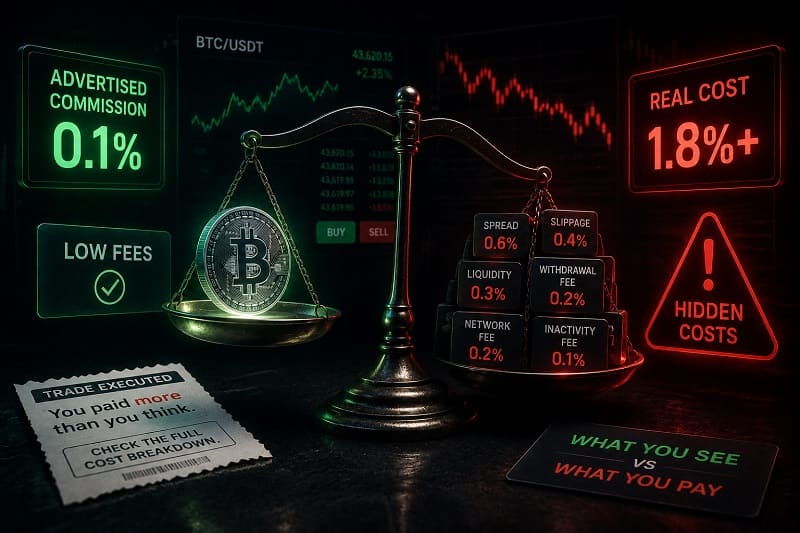
A platform can advertise a tiny commission and still leave a customer with less money than expected. The number on a pricing page usually reflects only the execution of an order. It does not necessarily include the way funds enter the account, the rate offered during a quick purchase, the cost of moving coins elsewhere, or the expense of returning proceeds to a bank.
For this reason, the lowest advertised rate is not always the most economical route. The useful comparison is the final result: how much asset arrives after a purchase, and how much fiat remains after a sale and payout.
The Number on the Pricing Page Is Only a Starting Point
Most people begin by comparing maker and taker percentages. That makes sense for regular traders who use an order book and place larger volumes. For a first-time buyer, however, this figure may be only one small part of the transaction.
A simple purchase can involve several separate stages:
- Money may be added by card or bank transfer.
- The customer then receives a quote, completes a purchase, possibly swaps one asset for another, and may later send the balance to a private wallet.
- Each stage can affect the final amount.
Consider a purchase of $1,000 worth of Bitcoin. A visible 0.1% commission equals $1. But if the offered quote is 1% away from a wider market reference, the difference is around $10 before any card charge or transfer expense is considered. The lesson is not that every quick-buy service is overpriced. It is that one percentage rarely describes the whole journey.
Three Different Things That Change the Final Price
The terms commission, spread, and slippage are often treated as if they mean the same thing. They do not.
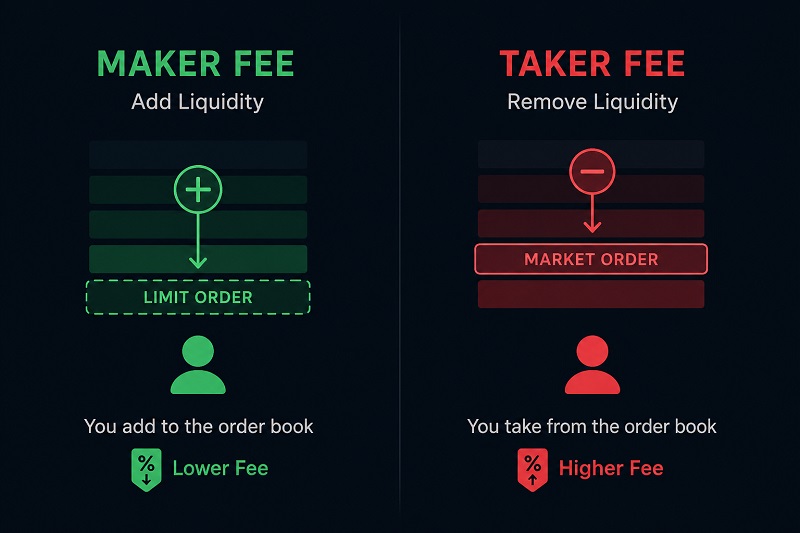
- A commission is a stated charge for processing an order. It is usually visible before confirmation and may depend on whether the customer adds liquidity to the market or takes available liquidity immediately.
- A spread is the difference between a market reference and the buy or sell quote shown to the customer. It is often built into the displayed price. Coinbase explains that the spread is the difference between the current market price and the price at which a customer buys or sells an asset. Its disclosures also state that a spread can apply to simple buying, selling, and conversions.
- Slippage is the movement between the expected price and the actual fill. It becomes more relevant when the market is moving quickly, the asset has limited liquidity, or a large market order consumes several price levels. A market order executes immediately, but it can fill in portions at different prices.
| What Changes the Result | How It Reaches the User | When It Becomes Important | Useful Check Before Confirming |
|---|---|---|---|
| Order commission | Shown as a separate amount or percentage | Spot and advanced-market activity | Current account tier and order type |
| Quoted-price spread | Included in the buy, sell, or swap rate | Simple purchase screens and conversion tools | Compare the quote with a live market reference |
| Slippage | Final fill differs from the price seen at submission | Large market orders or thin markets | Available order-book depth |
| Funding charge | Added by a card issuer, bank, or payment provider | When money first enters the account | Terms for the chosen payment method |
| Transfer charge | Fixed deduction in coins or fiat | When value leaves the platform | Minimums, network choice, and destination rules |
A spread is not automatically hidden or improper. It may be disclosed clearly in a platform’s documentation. It is simply easier to overlook because the customer often sees one final price instead of a separate line item.
Also Read: Can You Get Scammed on Coinbase?
A “Buy” Button Can Lead to Several Different Products
Large services now commonly offer more than one route to the same asset. A customer may use:
- a one-click purchase screen,
- a conversion function,
- a scheduled plan,
- a market order,
- or a limit order.
These options are not identical, even when they lead to the same Bitcoin or stablecoin balance.
The retail route is designed to reduce friction. It provides a quote and lets the user confirm quickly. The advanced route gives more control but expects the user to understand order types and market depth.
- Coinbase Advanced uses a volume-based maker-taker structure. Coinbase’s disclosures state that the advanced interface does not include a spread because users interact directly with the order book.
- Kraken’s published schedule lists a 1% trading charge for instant and recurring transactions, while its professional interface uses a separate volume-based model.
| Route | What the Customer Usually Sees | How the Price Is Typically Formed | Main Compromise |
|---|---|---|---|
| Quick purchase | A single price and a confirmation button | Quote can include a spread and payment-related charges | Speed is prioritised over detailed market visibility |
| Asset conversion | A direct swap between two balances | Rate may include a margin within the quote | Convenient, but not always easy to benchmark |
| Market order | Immediate execution | Available orders are matched at current prices | Final fill can vary during volatility |
| Limit order | A price chosen by the customer | Order waits until the market reaches that level | It may not execute at all |
| Scheduled purchase | Automatic buying at set intervals | Depends on the service’s recurring-order terms | Convenience does not guarantee the best execution |
Neither approach is universally superior. A limit order can offer more price control, while a quick purchase can be easier for someone who values simplicity. The important point is to avoid treating them as the same product with different buttons.
Why “Zero” Does Not Always Mean Nothing Is Paid
Promotions can be useful, but their conditions matter. A zero-rate offer may apply only to selected pairs, a particular product, a monthly threshold, or a limited period.
- Coinbase’s own materials explain that some Coinbase One trades have no transaction commission, while a spread may still be included in the quoted price. The benefit also excludes Coinbase Advanced and certain other products.
- Kraken+ similarly offers zero transaction charges up to stated monthly limits, but its FAQ distinguishes that benefit from other possible pricing elements.
Before relying on a promotion, it is worth checking four points:
- Does it apply to the interface being used?
- Is the quote competitive at the moment of confirmation?
- What happens when the asset is sent elsewhere?
- Will the bank, card issuer, or currency conversion create another deduction?
The wording on a banner may be accurate. It may simply describe one layer rather than the entire transaction.
Small Transfers Often Reveal the Bigger Problem
A fixed network or platform charge has a very different effect depending on the size of the transfer.
For a person moving a large balance once, the deduction may be relatively minor. For someone withdrawing a small amount every few days, the same fixed amount can take a noticeable share of the balance. This is why a service that looks inexpensive for active order-book trading may be unsuitable for a user who prefers frequent self-custody transfers.
Coinbase notes that certain USDT withdrawals can involve a processing charge as well as a separate network transaction charge.
The practical questions are simple:
- Is there a minimum amount that can be sent?
- Which network is being used?
- Is the wallet compatible with that network?
- Does it make more sense to consolidate several small balances before moving them?
A mistake in network selection can be more costly than the original trade. The cheapest route is not useful if the destination cannot receive the asset correctly.

The Exit Matters Before the Purchase Is Made
Many comparisons stop at the point where a person acquires an asset. Yet the final outcome may depend on how easily the balance can later be turned into ordinary money.
Selling may involve another quoted rate or order commission. A payout can involve a transfer charge, a foreign-exchange conversion, or a deduction made by an intermediary bank. These factors are especially important for people who expect to withdraw funds regularly rather than hold them for years.
| Part of the Journey | Potential Source of Loss | Why It Is Commonly Ignored |
|---|---|---|
| Adding funds | Card processing, bank transfer, or currency conversion | The customer is focused on the purchase itself |
| Entering or leaving a market | Commission, spread, and price movement during execution | Only one element may be displayed as a separate amount |
| Changing one asset into another | Less favourable conversion rate | The action may be presented as a simple swap |
| Moving assets to a wallet | Platform and network deductions | Fixed charges are easy to underestimate |
| Returning to a bank account | Sale pricing, payout charge, FX, and banking deductions | This stage feels distant when the account is first opened |
Someone who plans to receive euros or dollars each month may value a reliable local payout route more than a slightly lower spot-market percentage. A person who wants long-term self-custody may care more about transfer conditions. The best choice depends on how the account will actually be used.
Also Read: Can Someone Send Fake Bitcoin to Your Coinbase Account?
A More Useful Comparison Method
Rather than reading only the headline rate, compare the final confirmation screens on two or three platforms.
Check the amount of fiat being spent, the precise quantity of the asset received, the quoted execution price, and every deduction shown before confirmation. Then look ahead: what would it cost to send the asset out, sell it later, and transfer the proceeds to a bank?
A practical framework is:
Money in + purchase pricing + asset movement + conversion + money out = the real result.
It is not a formula that predicts every future market condition, but a way to make sure that one visible number does not hide the rest of the route.
Common Errors That Make a “Cheap” Trade Expensive
New users often make similar mistakes:
- choosing a platform solely because of its maker-taker schedule;
- accepting the first quick-buy quote without comparison;
- making several small swaps instead of planning the route;
- sending out tiny balances repeatedly;
- overlooking a minimum transfer requirement;
- using a network that the receiving wallet does not support;
- assuming a promotional offer covers all products;
- forgetting that a bank or card provider can apply its own charge.
The most reliable source for a current price is the final confirmation screen and the official schedule for the exact product being used. Public discussions can help identify common questions, but they should not replace the platform’s own terms.
Conclusion
A low commission can be meaningful, but it is never the entire story. The final result depends on the route a customer takes from the first deposit to the final withdrawal.
For frequent traders, order-book depth and maker-taker pricing may be decisive. For occasional buyers, the quality of the quote and the simplicity of the payment process may matter more. For users who need regular bank access, the final payout route can outweigh a small difference in trading rates.
The most sensible comparison is not between two advertised percentages. It is between two complete financial journeys.
FAQ
Is a spread the same as a trading commission?
No. A commission is usually charged separately. A spread is included in the difference between a market reference and the price offered to the customer.
Why can a quick purchase cost more?
It may use a quoted rate that includes a spread, along with possible payment-related charges.
Does a zero-rate offer mean the transaction is free?
Not necessarily. A spread, payment charge, network deduction, or bank cost may still apply.
What is slippage?
It is the difference between the expected execution price and the price at which an order actually fills.
Why are fixed transfer charges important?
They can represent a much larger percentage of a small balance than of a large one.
Are limit orders always cheaper?
No. A limit order may not fill, and if it executes immediately it can be treated as a taker order under the relevant pricing rules.
Can the bank add costs after I sell an asset?
Yes. Depending on the payment route, foreign-exchange charges, intermediary deductions, or receiving-bank charges may apply.
What should I compare before choosing a platform?
Compare the final purchase quote, the amount received, funding terms, transfer conditions, and the likely cost of converting proceeds back into fiat.
Sources
- Coinbase — Pricing and Fees
- Coinbase — Spread and Slippage Guide
- Coinbase Advanced Fees
- Coinbase Advanced Order Types
- Kraken Fee Schedule
- Kraken Fee Overview
- Kraken+ FAQ
Need Help?
If you chose a trading platform based on its low advertised commissions — only to discover that hidden spreads, inflated exchange rates, withdrawal fees, or other undisclosed charges have silently eaten into your funds — you can request a free consultation with StockView specialists.
An expert review can help assess whether these practices cross the line into deceptive conduct or outright fraud, and evaluate whether you may have realistic grounds for recovering lost funds through chargebacks, payment provider disputes, or regulatory complaints.
Get professional help with your case.