Is Bytnex Legit? Examining the Cryptex Connection and Regulatory Warnings
- What Is Bytnex?
- Understanding the Cryptex Connection
- Why People Started Asking Questions
- What Users Are Saying
- Does the Structure Resemble a Ponzi Scheme?
- Key Risk Factors
- What Should Potential Participants Verify?
- Conclusion
- FAQ
- Sources
- Need Help?
The cryptocurrency industry continues to attract people searching for alternative ways to build wealth. Many projects promote passive income, automated earnings, and long-term growth without requiring extensive trading knowledge.
At the same time, regulators around the world regularly warn consumers about operations that make ambitious promises while providing limited information about how profits are generated.
One project that has drawn increasing attention is Bytnex. Discussions surrounding the venture often focus on its reported relationship with Cryptex, an earlier operation that became the subject of warnings from financial authorities in several jurisdictions. Public records show that regulators in Austria and Germany issued notices connected to Cryptex and domains later associated with Bytnex-related branding.
As a result, many observers are asking whether the newer brand represents a legitimate business venture or simply a continuation of an operation that has already attracted regulatory scrutiny.
What Is Bytnex?
According to promotional materials, Bytnex is built around staking-related activities, smart-contract technology, and long-term participation plans.
The concept is marketed as an opportunity for individuals to contribute relatively small amounts and potentially receive larger payouts in the future. Promotional content often highlights accessibility and emphasizes that extensive market knowledge is not required to participate.
Supporters describe the model as a passive approach to the digital-asset sector. Critics, however, point to the limited availability of independently verifiable information regarding ownership, management, corporate structure, and oversight.
For many people researching the project, one of the primary concerns is not the marketing message itself but the difficulty of confirming how the operation generates revenue and who ultimately controls it.
Understanding the Cryptex Connection
Much of the discussion surrounding Bytnex originates from events that occurred before the new branding appeared.
Cryptex spent several years promoting staking-related participation plans and expanding through online communities. During that period, authorities in multiple countries began publishing warnings connected to the operation.
-
In April 2025, Austria's Financial Market Authority stated that Cryptex did not possess authorization for the distribution of a product that the regulator classified as an alternative investment fund. The authority also reminded consumers that certain financial activities require appropriate licensing.
-
German regulator BaFin later issued warnings involving websites linked to both the earlier brand and domains associated with Bytnex. Those notices referenced cryptocurrency-related services allegedly being offered without authorization.
Independent investigators have argued that the transition occurred shortly after Cryptex domains became unavailable. Reports published by industry watchdogs claim that new websites were registered while existing participants were directed toward the updated branding.
Whether this sequence represents a routine migration or a deliberate rebranding effort remains a matter of debate. Nevertheless, the timing continues to attract attention.
| Date | Reported Event |
|---|---|
| 2023 | Cryptex promotes crypto investment contracts |
| April 2025 | Austria issues regulatory warning |
| July–August 2025 | Germany issues multiple warnings |
| September 2025 | Australia-related warning activity reported |
| October 2025 | Cryptex domains become unavailable |
| October 2025 | Bytnex branding appears |
| 2026 | Regulatory warnings continue referencing Bytnex-related domains |

Why People Started Asking Questions
Regulatory activity is not the only reason the project has become controversial.
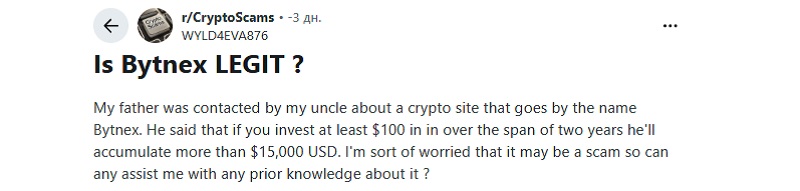
Online discussions frequently focus on earnings projections shared by promoters. In one widely discussed example, a Reddit user described a situation involving claims that a relatively small contribution could eventually grow into a substantially larger amount over time.
From a financial perspective, projections of this nature deserve careful examination.
| Claim | Risk Assessment |
|---|---|
| $100 becoming $15,000+ | Extremely aggressive growth assumption |
| Passive income generation | Requires independent verification |
| Low-entry investment model | Common in MLM-style promotions |
| Long-term guaranteed outcomes | High-risk warning sign |
Consumer-protection agencies regularly warn that extraordinary profit expectations combined with limited discussion of risk deserve additional scrutiny. Similar observations have appeared in research examining cryptocurrency-related fraud schemes.
What Users Are Saying
Questions surrounding the project extend beyond regulatory concerns.
- Across cryptocurrency forums, review websites, and online communities, discussions often focus on the sustainability of the advertised model. Participants frequently debate whether the projected rewards can realistically be supported by identifiable business activity.
- Some community members describe situations in which relatives or friends became interested after being shown calculations suggesting substantial future growth from relatively small starting amounts.
- Others have questioned agreements that require capital to remain committed for extended periods. In several discussions, contributors expressed uncertainty regarding whether the projected outcomes could be achieved under the structure being promoted.
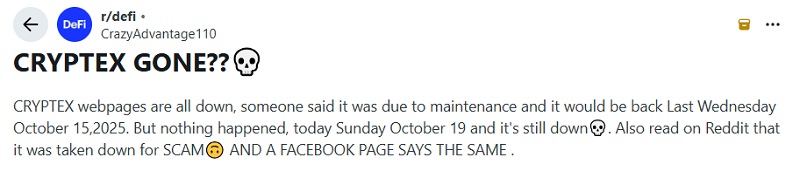
- Additional skepticism emerged after websites associated with the earlier brand became unavailable. Many observers attempted to determine whether the newer venture represented a continuation of existing operations or an entirely separate business.
Although individual accounts should always be viewed cautiously, the consistency of these themes has contributed to ongoing debate within the broader digital-asset community.
Does the Structure Resemble a Ponzi Scheme?
This question is frequently raised whenever projects promise unusually high rewards over long periods.
Financial researchers generally define a Ponzi scheme as a structure in which money contributed by newer participants is used to satisfy obligations owed to earlier members rather than being generated through legitimate underlying activity.
Studies examining cryptocurrency-related fraud have identified several warning signs that commonly appear in problematic operations.
None of these indicators alone can determine how a business operates.
However, when several warning signs appear simultaneously, the overall risk level increases. Academic studies examining digital-asset fraud repeatedly note that unrealistic growth projections, referral-based expansion, and limited transparency often appear together in high-risk ventures.
For that reason, anyone considering participation should carefully examine how rewards are generated and whether those revenue sources can be independently verified.
| Common Ponzi Characteristic | Reported for Bytnex? |
|---|---|
| High promised returns | Reported |
| Recruitment incentives | Reported |
| Long lock-up periods | Reported |
| Limited operational transparency | Observed |
| Regulatory scrutiny | Observed |
Key Risk Factors
Several concerns appeared repeatedly during this review.
| Risk Indicator | Present? |
|---|---|
| Regulatory warnings | Yes |
| Rebranding following scrutiny | Reported |
| Very high return claims | Reported |
| MLM-style promotion | Reported |
| Limited ownership transparency | Yes |
| Long-term lock-up contracts | Reported |
Viewed separately, some of these concerns may have legitimate explanations.
Taken together, however, they create a risk profile that differs substantially from what consumers typically expect from transparent and regulated financial-service providers.
Particularly noteworthy is the combination of official warnings, questions surrounding the transition from Cryptex, and concerns about the sustainability of projected earnings. While none of these factors alone proves misconduct, their accumulation warrants careful examination.
What Should Potential Participants Verify?
Before committing money to any cryptocurrency-related venture, independent verification is essential. Areas that deserve particular attention include:
- licensing and regulatory status;
- ownership and management information;
- corporate registration records;
- audited financial disclosures;
- identifiable revenue sources;
- procedures for accessing balances and withdrawing assets.
It is also advisable to avoid making decisions based solely on recommendations from friends, relatives, social-media personalities, or referral marketers.
Whenever projected gains appear unusually high, additional due diligence becomes especially important.

Conclusion
Bytnex cannot be evaluated in isolation. Its reported connection to Cryptex, combined with official warnings, ambitious earnings projections, recruitment-focused growth claims, and concerns raised within online communities, creates a risk profile that deserves careful consideration.
Publicly available information suggests that many questions previously associated with the earlier operation have continued to follow the newer brand. Authorities in Austria and Germany have published notices involving related entities and domains, while community discussions continue to debate the sustainability of the model being promoted.
These factors do not automatically prove wrongdoing. However, anyone considering involvement should proceed cautiously, independently verify major claims, and fully understand how the business generates revenue before committing capital.
FAQ
Is Bytnex regulated?
No widely recognized authorization from major financial regulators could be independently verified during this review.
Is Bytnex connected to Cryptex?
Multiple investigations and community reports claim that the project emerged after Cryptex-related domains became unavailable.
Why did the transition occur?
Independent researchers reported that new branding appeared shortly after the original websites disappeared, although the exact reasons remain disputed.
Has BaFin issued notices involving Bytnex?
Yes. German regulator BaFin published warnings involving domains connected to the operation, including secure-bytnex.io.
Are projected earnings guaranteed?
No. Any claims regarding future performance should be independently verified, and no outcome can be guaranteed.
Does the project rely heavily on recruitment?
Many community discussions and investigations describe a strong emphasis on referral activity. Prospective participants should review the compensation structure carefully.
What is a crypto Ponzi scheme?
It is a financial structure in which payouts are funded primarily through money contributed by newer participants rather than through legitimate business activity.
What should people verify before sending money?
Ownership details, regulatory status, financial disclosures, revenue sources, and withdrawal procedures should all be reviewed before committing capital.
Sources
- Austrian FMA Warning on Cryptex
- BaFin Warning Referencing Bytnex Domains
- Cryptex Reboots as Bytnex Following Domain Seizure
- Reddit discussions
- Academic Research on Bitcoin Ponzi Schemes
- Characterizing Cryptocurrency Exchange Scams
Need Help?
If you registered or deposited funds on Bytnex — especially if you were unaware of its connection to the Cryptex ecosystem or overlooked regulatory warnings issued against the platform — and you're now facing withdrawal restrictions, frozen accounts, or unresponsive support, you can request a free consultation with StockView specialists.
An expert review can help assess whether Bytnex exhibits patterns associated with flagged entities and evaluate your realistic options for recovering lost funds, including chargeback claims, payment provider disputes, and coordinated regulatory follow‑up.
Get professional help with your case.